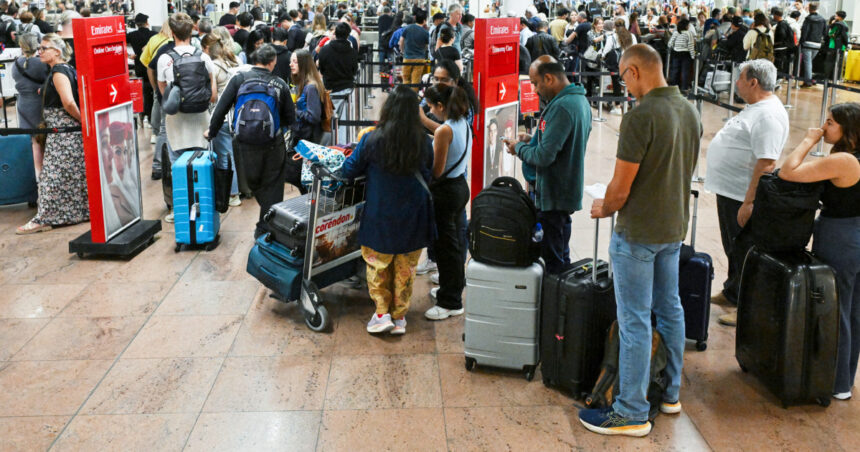
Passenger travel across several European airports faced significant disruptions due to a cyberattack that affected check-in systems, entering its second day on Sunday. The incident particularly impacted Brussels Airport, which reported extensive cancellations and delays as airlines struggled to manage the fallout.
Brussels Airport announced the cancellation of nearly 140 departing flights for Monday, attributing the decision to a U.S.-based software provider, Collins Aerospace, which had yet to deliver a secure updated version of its check-in system. The situation worsened over the weekend, with 25 flights canceled on Saturday and 50 on Sunday, resulting in substantial frustration for travelers.
The cyberattack began late Friday, affecting electronic systems at airports in Berlin, Brussels, and London. Staff members at these airports resorted to manual check-in methods, including handwriting boarding passes and using backup laptops to assist stranded passengers. However, several other European airports remained unaffected by the disruptions, highlighting a localized issue.
Collins Aerospace, which provides critical software for check-in operations, confirmed a “cyber-related disruption” affecting select airports in Europe. While the specific perpetrators behind the attack remain unknown, cybersecurity experts suggest that it could involve hackers, organized crime, or state-sponsored actors.
The European Commission stated that despite the disruptions, aviation safety and air traffic control systems were functioning normally, indicating that the incident did not represent a broader or severe threat. Investigations into the origins of the cyberattack are ongoing.
In the aftermath, Brussels Airport reported that it was forced to request airlines to cancel half of the 276 scheduled departures for Monday, underscoring the prolonged nature of the issue. The airport noted that operations would continue to be hindered as long as manual check-in processes were necessary.
Despite these considerable challenges, Brussels Airport managed to maintain about 85% of its scheduled departures over the weekend, thanks in part to the deployment of additional staff and the continued functionality of self-service options.
RTX Corp., the parent company of Collins Aerospace, has not yet commented on the situation despite previous assurances that the impact was primarily limited to electronic check-in operations. The company stated that manual check-in processes could mitigate some of the disruptions.
Airports advised travelers to check their flight statuses online and utilize alternative check-in methods wherever possible. Statements from Heathrow and Brandenburg Airports acknowledged ongoing challenges but emphasized that the majority of flights were able to proceed thanks to collaborative efforts among airline partners.
As the recovery process continues, affected airports remain vigilant and are actively implementing backup systems to ease the burden on passengers during this tumultuous period.