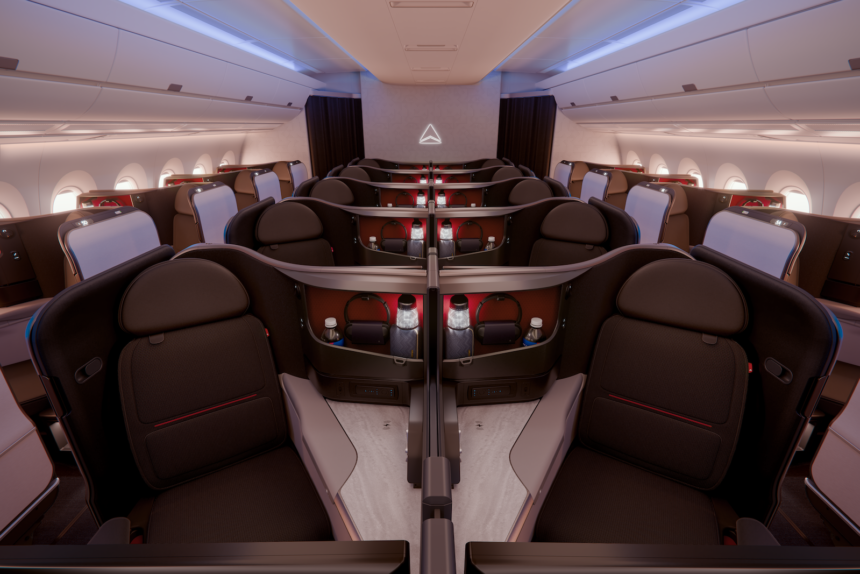
Delta Air Lines is set to make waves in the aviation industry with the unveiling of its next-generation Delta One suites, aimed at enhancing the business-class travel experience. This new product comes nearly a decade after the introduction of the original Delta One cabin, which raised the standards for luxury air travel in the U.S. The upgraded Delta One will debut on the airline’s Airbus A350-1000, scheduled for delivery in 2027.
The A350-1000 will feature a total of 53 Delta One suites—a 33% increase compared to existing aircraft. This move is reflective of Delta’s strategy to stay competitive among major airlines, particularly as rivals enhance their premium offerings. Alongside the new suites, the A350-1000 will also boast state-of-the-art technology, including advanced seatback screens that have been teased by Delta for over a year.
Mauricio Parise, Delta’s vice president of brand experience, emphasizes that the new Delta One suites represent an evolution of the existing product, which has received accolades from travel experts. “It’s an optimization of a product that’s already great,” Parise stated, highlighting that the suites will include features such as lie-flat beds, sliding privacy doors, and enhanced comfort elements like Missoni bedding.
The redesigned suites will offer lie-flat seats measuring 83 inches—3 inches longer than the current configuration—supplemented with a plush pillowtop layer for added comfort. Additionally, travelers can look forward to thoughtful design elements, including a glasses hook, a shoe cubby, bedside trays for personal items, and improved accent lighting.
Each suite will be outfitted with 24-inch 4K seatback screens, providing some of the largest personal screens in the industry. However, unlike some competitors, Delta has not indicated plans for an extra-large business-class row on its A350-1000s, opting instead for a more uniform suite experience.
In addition to the business-class offerings, the A350-1000 will consist of 48 Premium Select recliners in a 2-4-2 configuration and 152 regular economy seats. This configuration reflects Delta’s emphasis on upscale travel options while still accommodating a broader range of passengers.
The A350-1000 is designed for long-haul travel, boasting a range of 8,700 nautical miles. This makes it suitable for international destinations where demand for premium seating is high, such as India and Saudi Arabia, with plans to begin flights to Riyadh in the near future.
Furthermore, Delta has announced significant refresh plans for its older Airbus A330-200 and -300 fleets. Starting in September, the airline will undertake comprehensive cabin upgrades for 42 of these aircraft. These improvements will include the introduction of Delta One suites with many similar features found in the new A350-1000, such as pillowtop mattresses and enhanced technology. The refreshed A330s will also include walk-up refreshment stations and an increased number of Premium Select and Comfort seats.
As Delta shapes its future, the airline aims for 90% of its Delta One seats to feature suites with sliding doors by 2030. However, a notable exception will be its Boeing 767-400s, which, while being relatively updated, lack doors. The airline plans to phase out its older Boeing 767-300s in the coming years, signaling a commitment to modernizing its fleet.
Delta’s initiatives reflect a broader trend of elevated travel experiences in the industry, as airlines continue to innovate and enhance their offerings to meet evolving passenger expectations.