









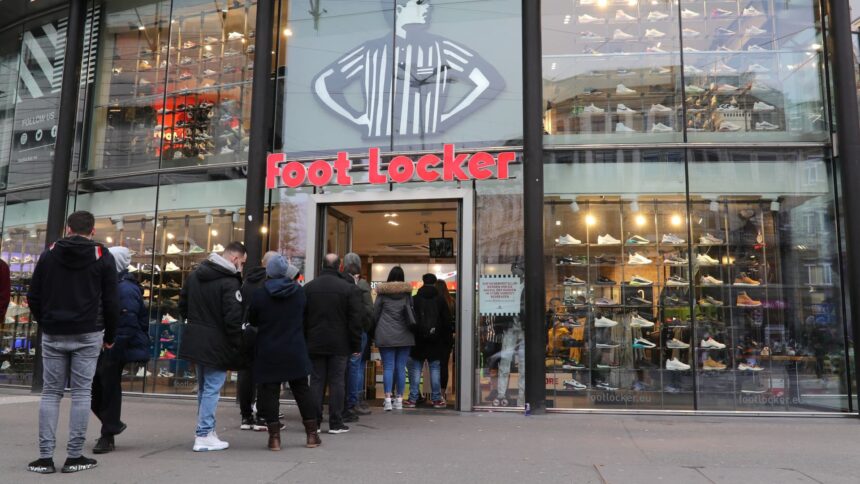
Dick’s Sporting Goods has reported stronger-than-anticipated results for the holiday quarter, although it has also issued a cautious outlook for the upcoming fiscal year, citing the ongoing financial impact of its acquisition of Foot Locker. The retailer forecasts that adjusted earnings per share for fiscal 2026 will fall between $13.50 and $14.50, a dip from the projected $14.67 from analysts, according to data from LSEG.
The company remains optimistic about Foot Locker’s potential for recovery, projecting a return to both profit and sales growth. However, significant challenges persist as Dick’s aims to rectify problems related to outdated inventory and less productive store locations that were part of the merger. The expenses associated with these efforts, along with other costs stemming from the acquisition, are expected to total between $500 million and $750 million. Of that, approximately $390 million was recognized in fiscal 2025, with further costs anticipated in the current fiscal year.
In an interview with CNBC, Executive Chairman Ed Stack indicated that the company has made substantial progress in streamlining Foot Locker’s operations, stating, “We are basically done” with the resizing efforts. He stressed that ongoing adjustments should be viewed as standard practice in the retail sector.
For the fiscal fourth quarter, Dick’s exceeded Wall Street’s expectations, reporting earnings and revenues higher than anticipated. The results showed earnings of $3.45 per share, adjusted, compared to the expected $2.87, while revenue reached $6.23 billion, surpassing the forecast of $6.07 billion. However, the company’s net income saw a notable decline, falling to $128.3 million, or $1.41 per share, down 57% from $299.97 million, or $3.62 per share, during the same period last year. Excluding one-time expenses related to the Foot Locker acquisition, Dick’s adjusted earnings stood at $3.45 per share.
Sales soared to $6.23 billion, reflecting a substantial increase from $3.89 billion a year prior, when Foot Locker was not included in the company’s portfolio. The acquisition, which took place six months ago for $2.5 billion, has enabled Dick’s to become a prominent distributor for leading athletic brands like Nike, Adidas, and New Balance. This merger has not only enhanced its customer base and international reach but also bolstered its negotiating power with brands at a time when companies are shifting away from traditional wholesale models.
Despite the growth attributed to the acquisition, Foot Locker has struggled with performance issues in recent years, primarily due to its extensive mall-based store footprint. Since the acquisition, Dick’s has actively worked to close underperforming locations, shutting down 57 stores across Foot Locker, Champs, Kids Foot Locker, and WSS in fiscal 2025. Concurrently, a pilot program called “Fast Break,” involving 11 Foot Locker stores, has been launched to experiment with new product offerings and store presentations. Early reports indicate that the pilot has produced strong results through improved in-store storytelling and a more curated product selection. Dick’s plans to expand the Fast Break model later in the year.
Ahead of the acquisition, Foot Locker’s previous CEO, Mary Dillon, had initiated a transformation strategy focused on relocating stores to off-mall locations and updating existing stores with modern concepts. It remains uncertain whether the Fast Break initiative will align with or diverge from these prior efforts.
Looking ahead, Dick’s anticipates an improvement in Foot Locker’s comparable sales and profitability, particularly as the back-to-school shopping season approaches. For the full fiscal year, the company projects that comparable sales for Foot Locker will increase between 1% and 3%.