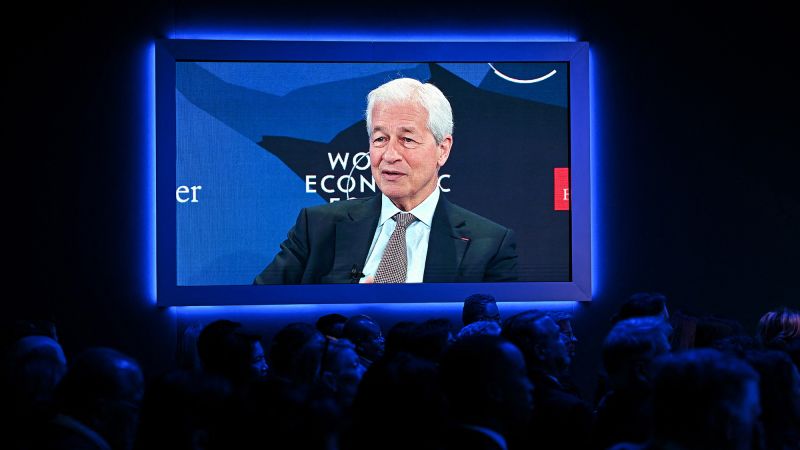
During a question-and-answer session at the World Economic Summit in Switzerland, Jamie Dimon, CEO of JPMorgan Chase, limited his critique of President Donald Trump, singling out one policy proposal for strong condemnation. Dimon characterized Trump’s recent call for a 10% cap on credit card interest rates as potentially catastrophic for the U.S. economy.
While Dimon refrained from discussing other contentious issues, such as immigration and trade, he was unequivocal about the implications of Trump’s interest rate proposal. The President had previously asserted via social media that Americans are being “ripped off” by excessive interest rates and vowed to seek congressional approval for a year-long cap.
Dimon forecasted severe repercussions for the nation’s economic landscape if the cap were to be enacted. He pointed out that while JPMorgan Chase would weather the storm, around 80% of Americans would find their credit access significantly diminished. He characterized the cap as a “backup credit” for many Americans, suggesting that it would inadvertently harm businesses and municipalities reliant on timely payments from consumers.
In a somewhat provocative suggestion, Dimon proposed that the government should first pilot the 10% cap in select states such as Vermont and Massachusetts—home to prominent liberal senators Bernie Sanders and Elizabeth Warren—arguing that advocates of the cap might learn valuable lessons from those experiments. He predicted that the backlash would not primarily come from credit card companies, but rather from industries such as retail and hospitality, where businesses would experience a ripple effect from missed payments.
Despite his candid concerns regarding the interest rate cap, Dimon expressed skepticism about the likelihood of Congress passing such a sweeping measure. He asserted that other political topics, especially those relating to foreign policy, are more complex and lack straightforward answers. Dimon admitted uncertainty regarding whether the Trump administration’s foreign policy makes the world safer, reflecting his desire for a more nuanced discussion rather than binary judgments.
Furthermore, Dimon addressed immigration policies, voicing criticism of both the Trump administration and the Biden administration, calling for a more measured approach to the ongoing crisis. He encouraged patience in discussions around immigration enforcement.
In a forward-looking perspective, Dimon spoke about the rapid advancement of artificial intelligence (AI) and its potential to disrupt the job market. He emphasized the need for proactive measures from both business leaders and government officials to address potential job losses resulting from AI implementation. Dimon pointed out that while AI may eliminate some positions, it could also create new job opportunities.
He advocated for collaborative strategies, urging governments to offer support and incentives to companies for retraining affected workers. Dimon suggested that such initiatives could help mitigate societal unrest stemming from swift technological changes, emphasizing the importance of local-level interventions that can adapt to specific community needs.
Overall, Dimon’s remarks at Davos highlighted his cautious engagement with political matters and his focus on the implications of major economic policies, signaling both a pragmatic and socially responsible approach to corporate leadership.