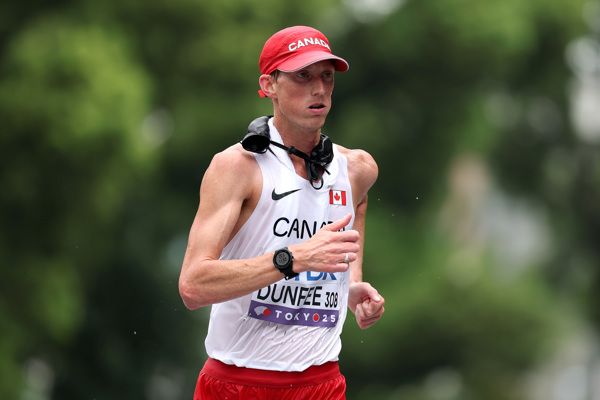
In a gripping conclusion to the men’s 35km race walk at the World Athletics Championships in Tokyo, Japan’s aspirations for a golden start were thwarted as Canada’s Evan Dunfee claimed his first global title at the age of 34. The event unfolded with a dramatic narrative, showcasing the unpredictability of competitive athletics.
Masatora Kawano and Hayato Katsuki, both representing Japan, initially seemed poised for a spectacular home victory, thrilling spectators along the sun-drenched streets. However, their hopes took a sharp turn at the 27km mark when they were overtaken by Ecuador’s David Hurtado, who was later penalized with a significant three-and-a-half minute time penalty due to a third red card. This unexpected development dropped Hurtado out of contention, allowing Kawano to regain the lead, albeit briefly.
As the race progressed, it became evident that the oppressive humidity was taking its toll on Katsuki, who faltered midway through, even stumbling at one point. Dunfee, who had appeared to lag behind earlier in the race, showcased his experience and resilience as he gradually gained momentum, ultimately catching and surpassing his rivals. His pre-race assertion that “in the 35km race walk, it’s not over until it’s over” proved prophetic.
The drama intensified on the final lap when Dunfee visibly struggled, ceding ground to Brazilian competitor Caio Bonfim. Yet, despite the visible discomfort etched on his face, Dunfee summoned the strength to fend off Bonfim’s challenge, finishing with an impressive display of determination and celebrating as he crossed the finish line with the Canadian flag held high.
Dunfee’s victory marked a significant milestone in his athletics career, adding a world title to his previous accolades that included an Olympic bronze medal in the 50km event at the Tokyo Games and another bronze at the 2019 World Championships in Doha. This race also heralded the emergence of a new world champion, as Massimo Stano, the world record holder and gold medalist from the previous championships in Oregon, was unable to compete due to injury. Defending champion Alvaro Martin had retired earlier in the year, leaving the path open for a new victor.
Despite Dunfee’s recent world record of 2:21:40 set in March, his win came against a backdrop where the field had shifted dramatically in recent months. Ultimately, he finished more than half a minute ahead of Bonfim. Katsuki, who had briefly fallen out of the medal race, made an impressive comeback to secure a podium finish, much to the delight of the home crowd at the National Stadium. At 34, Katsuki’s decision to continue competing instead of retiring post-Olympics appeared to be a wise choice, possibly making this his final major race at this distance.
In stark contrast, Kawano was unable to sustain his earlier pace, finishing in 18th place, contemplating a missed opportunity. Hurtado’s aspirations for glory also fell short, as he finished ninth—over four minutes behind the leaders—yet he managed to celebrate his completion of the race, reminiscent of Ecuador’s past hero Jefferson Perez, who carved a path for his country in the sport. This thrilling race not only highlighted the perseverance of seasoned athletes but also set the stage for emerging stars in the world of athletics.