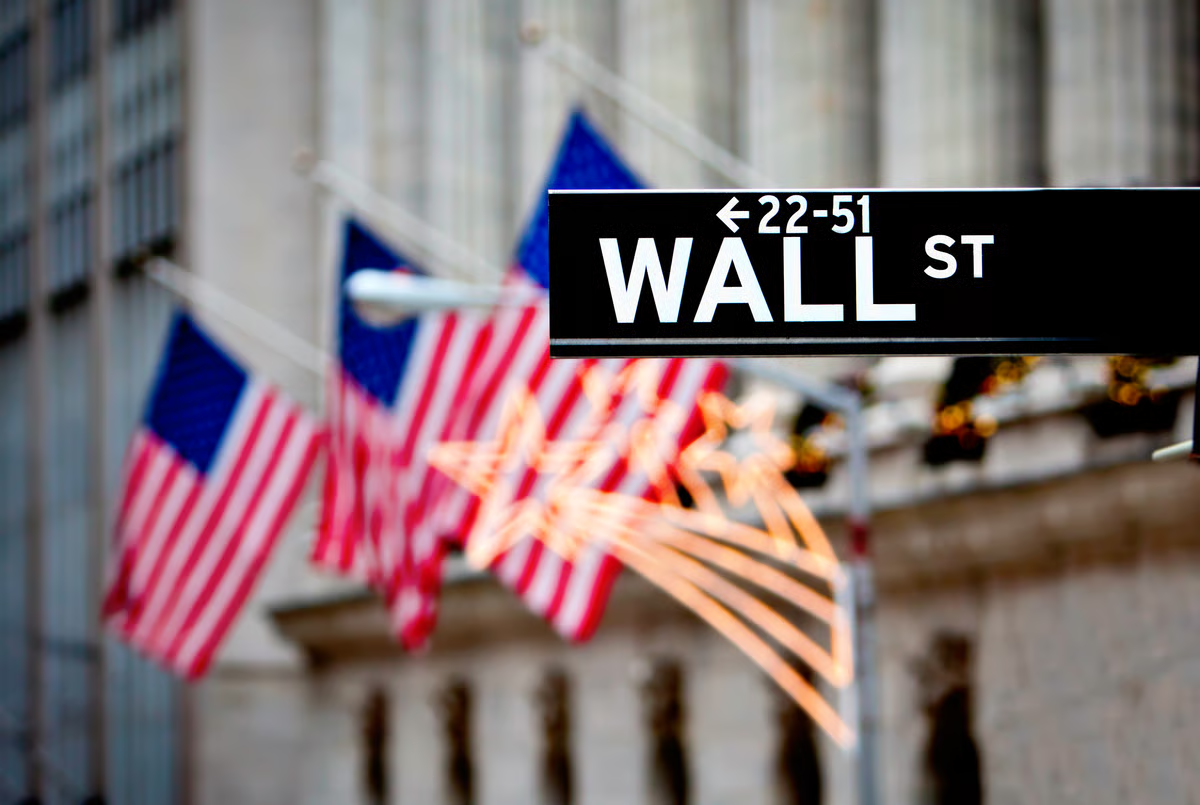
Rising economic and political uncertainty is causing stock market investors to feel apprehensive, as the benchmark S&P 500 index hovers down fractionally from its all-time high. Recent weeks have brought increased volatility, fueled by concerns about various factors affecting market stability.
A primary focal point has been OpenAI, a leading artificial intelligence start-up, which is struggling to uphold its significant financial commitments. Investors are wary that OpenAI may not have the capacity to meet its obligations, which could reverberate throughout the AI industry. The company has made colossal spending commitments, reportedly totaling hundreds of billions of dollars to major cloud providers like Microsoft Azure and Oracle Cloud Infrastructure. Additionally, it has secured an estimated $90 billion in chip orders from Advanced Micro Devices.
Despite generating only $20 billion in annual revenues, OpenAI is banking on substantial growth and continued investment inflows. However, uncertainty looms, notably with Nvidia—a key partner—reflecting hesitation in proceeding with a planned $100 billion investment into OpenAI. This potential financial strain raises questions about OpenAI’s ability to meet commitments, subsequently impacting demand for hardware from suppliers like Nvidia and threatening a domino effect throughout the AI sector.
Compounding the situation is an unsettling trend in the U.S. labor market. The unemployment rate is at 4.4%, near a five-year high, and recent job market statistics paint an even bleaker picture. According to the Job Openings and Labor Turnover Survey (JOLTS), available job positions in December totaled just 6.5 million, falling short of the 7.2 million predicted by economists. Additionally, recent layoffs exceeding 108,000 workers in January represent the highest January layoff figure since 2009, with several companies citing adverse economic conditions and restructuring as reasons for reductions in workforce.
The manufacturing sector has suffered particularly severe job losses, with around 72,000 jobs disappearing since the announcement of the “Liberation Day” tariffs by President Trump last April. Intended to bolster American competitiveness, the tariffs have instead escalated costs for businesses importing raw materials and components, hindering the manufacturing industry’s recovery.
Stock market corrections are typical and part of the investment landscape. Historical data shows the S&P 500 experiences declines of 5% or more on average once a year, and corrections of at least 10% occur every two and a half years. Although bear markets are less frequent, they do occur approximately every six years. Excluding the brief 20% drop related to “Liberation Day,” the last substantial bear market was noted in 2022, suggesting the current bull market could have further room for growth.
However, the S&P 500 currently trades at a historically high valuation, which may foreshadow potential downturns. Should a correction of 10% arise, analysts anticipate a bottom around 6,300. Nevertheless, corporate earnings remain robust, making it uncertain whether current labor market weaknesses will trigger an economic recession. Interestingly, fears surrounding the AI sector could be largely priced into some stocks, such as Oracle, which has seen its shares decline by 52% from record levels.
Ultimately, whether a significant sell-off occurs in the near future or in several years, historical trends indicate the S&P 500 is poised to rebound and achieve new highs. Therefore, long-term investors may wish to perceive any market weakness as a potential buying opportunity rather than a cause for panic.