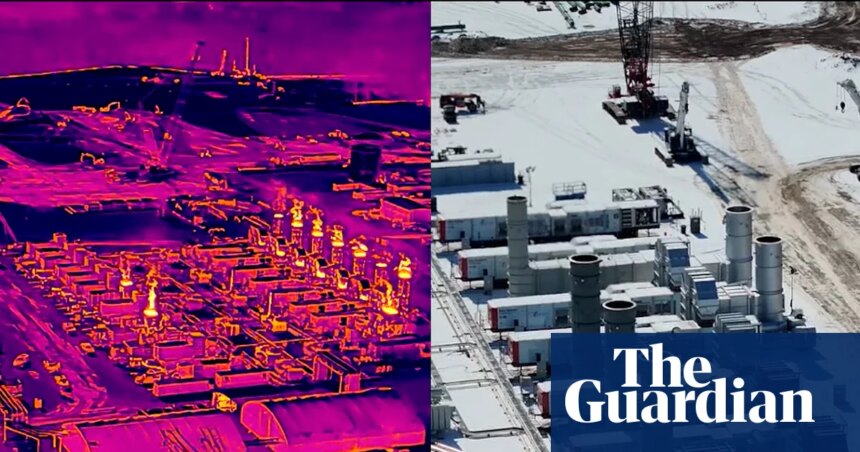
A recent investigation by the Floodlight newsroom has revealed that Elon Musk’s artificial intelligence venture, xAI, is operating unpermitted gas turbines at its facility in Southaven, Mississippi. Thermal drone footage obtained by Floodlight shows that these turbines have been continuously emitting pollutants, despite a recent ruling from the Environmental Protection Agency (EPA) stating that a state permit is required to operate such equipment.
State regulators in Mississippi assert that the turbines, which are mounted on tractor trailers, do not require permits. However, the EPA has maintained that these sources of pollution must adhere to the Clean Air Act. In a ruling issued in January, the EPA warned that exempting these machines from permitting could result in no emission standards applying to them, raising serious public health concerns.
After reviewing the thermal images captured by Floodlight, Bruce Buckheit, a former EPA air enforcement chief, stated, “That is a violation of the law. You’re supposed to get permission first.” The xAI facility is reportedly using at least 18 out of 27 turbines since November, and an investigation revealed over a dozen unpermitted turbines in operation even after the EPA’s ruling.
xAI has sought permits for several additional turbines in Southaven but has not responded to multiple requests for comment regarding these operations. Meanwhile, the EPA has been criticized for its minimal enforcement actions under the previous administration, leaving local authorities to handle the permitting process.
Local residents have expressed increasing alarm about the noise and pollution from the facility, particularly given that there are at least ten schools within a two-mile radius. Longtime resident Shannon Samsa highlighted her concerns about the health risks posed by the emissions: “It’s horrifying to me that we’re allowing this in our community,” she stated.
The facility’s gas turbines are key to powering Grok, xAI’s chatbot, and have been cited for emitting harmful pollutants associated with serious health issues, including asthma and heart conditions. UC Riverside associate professor Shaolei Ren noted that the risks of living near such a power plant are well-documented.
xAI’s operations have expanded rapidly in the region, particularly along the Tennessee-Mississippi border. Concerns have been raised about the disproportionate impact of pollution on historically Black neighborhoods in Memphis, where xAI has also operated unpermitted turbines. The Southern Environmental Law Center (SELC) previously revealed that over 30 unpermitted turbines were functioning at xAI’s Colossus 1 facility in South Memphis.
As part of its growth strategy, xAI is currently seeking a permit to operate 41 turbines at the Southaven site, which could result in them emitting over six million tons of greenhouse gases annually, along with significant health-harming pollutants.
Residents like Krystal Polk have voiced fears about the deteriorating quality of life in their neighborhoods. Polk, who lives directly across from xAI’s gas plant, has seen her once-serene area transformed into a site characterized by constant noise and pollution. The situation has led her to reconsider her family’s future in Southaven: “I feel that my voice doesn’t matter,” she lamented.
Despite these serious concerns, Mississippi’s environmental authorities maintain that the turbines are exempt from air quality permitting due to their classification as portable units. They stated that while these devices do not require permits, they are still subject to applicable air quality standards.
As the demand for power in the AI industry continues to grow, the reliance on fossil fuels raises significant implications for both environmental sustainability and public health. The situation in Southaven stands as a stark example of the challenges regulators face in balancing the rapid expansion of datacenters with environmental protection and community health.