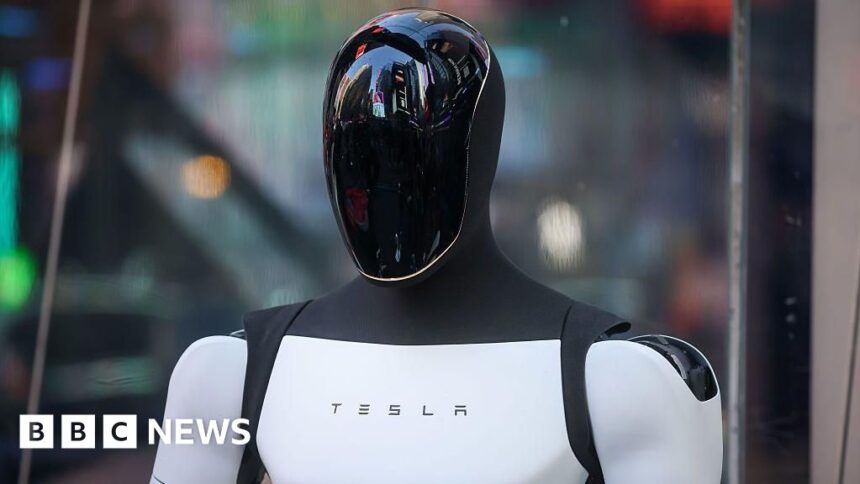
Tesla’s humanoid robot, Optimus, has been making appearances not only in showrooms and factory floors but has even caught the attention of celebrities like Kim Kardashian. Elon Musk envisions a future where Optimus plays an essential role in households, significantly impacting daily life across the globe. Musk has indicated that alongside self-driving robotaxis and Cybertrucks, these humanoid robots are critical to Tesla’s ambitions in the artificial intelligence sector.
In a recent development, Musk’s ambitious $1 trillion pay package hinges on a monumental goal: delivering one million AI bots over the next decade. This has sparked discussions about whether Tesla’s significant investment in humanoid robots is grounded in reality or merely speculative.
The interest in humanoid robots is surging, particularly in Silicon Valley. A report from Morgan Stanley highlights that tech giant Apple, which is reportedly exploring similar technologies, could potentially generate $133 billion annually from humanoid robots by 2040. Manufacturing company Foxconn is also reportedly planning to deploy humanoid robots in its Nvidia factory in Texas.
The concept of AI encased in human-like robots offers intriguing possibilities, allowing for interaction with the physical world—a feature that many believe could redefine how technology integrates into daily life. Various companies have pursued the development of human-like robots for industrial purposes. However, innovation has also entered the consumer sphere, as seen with the highly publicized Neo from tech firm 1X, scheduled for launch in 2026. This robot is designed for chores like emptying dishwashers and folding clothing, priced at $20,000, although it is reported to be remotely controlled by a person using virtual reality.
Forrester analyst Brian Hopkins notes that diminishing costs of components, along with improvements in robot dexterity and AI, are making humanoid robots increasingly viable across various sectors. He predicts that by 2030, humanoid robots could significantly disrupt industries such as warehousing, restaurant services, elder care, and security. Musk himself has stated that the impact of these robots might surpass that of Tesla’s vehicle business in the long term, offering potential advancements in artificial general intelligence (AGI) systems.
Boston Dynamics, known for its dynamic robots, has fascinated the public with its hydraulic humanoid Atlas, which showcases advanced capabilities through gymnastics and dance routines. The development of robots has accelerated, aided by a wave of AI advancements, with scientists now enabling machines to perform increasingly complex tasks. The retirement of Atlas marked a transition to a new, fully electric model designed for even greater agility.
Despite their allure, many robotics experts remain skeptical about the practicality of humanoid robots. Some argue that the complexity of creating bipedal locomotion isn’t justified, as wheeled robots are generally more efficient. Additionally, the need for a humanoid shape is questioned, with some experts pointing out that psychologically, humans might feel more comfortable with robots that resemble them, a fascination that has deep roots in science fiction.
Recent demonstrations of Tesla’s Optimus have showcased its capabilities in more public environments, where it has served food in Tesla’s Hollywood diner. While figures like Sam Altman, the CEO of OpenAI, have expressed skepticism about society’s readiness for humanoid robots, he acknowledges the inevitability of their arrival. Interestingly, both he and Musk seem aligned in their recognition that the development of humanoid robots is on the horizon, revealing Musk’s capacity to push the agenda forward through his influence and resources.