On a brisk Monday morning before Thanksgiving, a Secret Service motorcade carved through the small town of Vega, Texas, marking the arrival of a notable figure from national circles. Eric Trump, son of former President Donald Trump, arrived on a private jet from Florida, a visit that was shrouded in hushed secrecy, as confirmed by local county commissioner Quincy Taylor. “I probably wasn’t supposed to know,” she admitted.
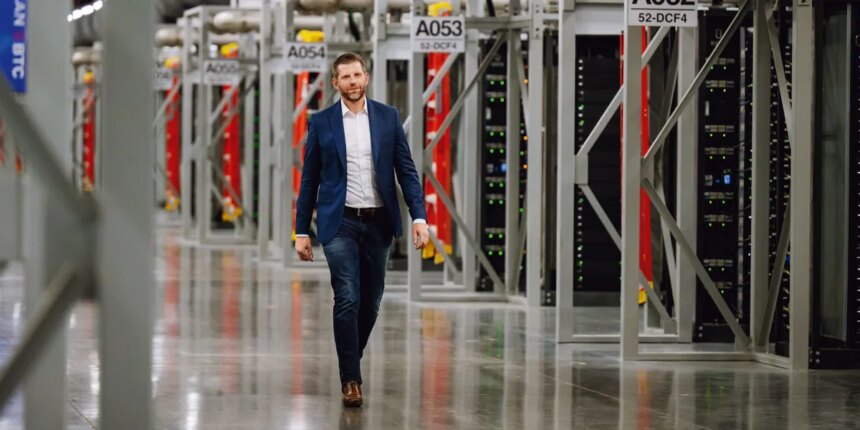
Shortly after his arrival, Eric Trump broke his silence via an Instagram post, announcing, “Hey, friends, it’s Eric Trump. Welcome to American Bitcoin,” in front of a sprawling array of computer servers at a newly established data center that stretches the length of five football fields. The facility, which went online in late June, is powered partially by local wind turbines, with Eric expressing a sense of beauty in the industrial landscape, clad in jeans and a blazer as he walked among the rows of technology.
American Bitcoin, co-founded by Eric Trump and launched in March 2025, aims to capitalize on the growing Bitcoin mining industry, which has seen the U.S. emerge as a leader in cryptocurrency creation. As Bitcoin’s market share increased, Eric Trump noted that the facility’s operations reflect a strategic vision aligned with his father’s broader goals of enhancing American dominance in various key industries. “If we don’t do it, someone else will,” he stated, emphasizing an ambition to position the U.S. as the crypto capital of the world.
Despite its promising narrative, American Bitcoin faces significant challenges and scrutiny. Since going public in September, the company’s stock price fell dramatically alongside Bitcoin’s value, raising concerns about potential conflicts of interest tied to its activities. Eric Trump remains optimistic about the long-term nature of cryptocurrency, suggesting that its volatility could yield substantial profits in the years to come.
Inside the facility, a crisis warranted immediate attention as technicians raced to repair malfunctioning servers, underscoring the drastic evolution of Bitcoin mining from the days when it could be done on a simple laptop. Now requiring immense computing power and specialized technological infrastructure, the Vega facility illustrates the industrial scale of contemporary cryptocurrency mining.
Bitcoin, originally conceived as a counteraction to traditional banking systems, has become synonymous with complex financial operations that require substantial energy inputs. The U.S. has increasingly established itself in this domain, currently accounting for 38% of global Bitcoin mining activity. This has been partially fueled by favorable energy costs in areas like Vega.
Eric Trump’s initiative coincided with President Trump’s executive order in March 2025 that emphasized the strategic importance of Bitcoin, further intertwining the family’s business interests with national economic policy. Eric Trump’s partnership with Asher Genoot, a seasoned player in the Bitcoin mining landscape, has led to a series of strategic financial maneuvers aimed at consolidating their position in the industry. Their collaborative ventures illustrate a blend of traditional real estate and innovative approaches to digital finance.
Despite the fluctuating nature of the cryptocurrency market, Eric Trump and his colleagues have actively engaged in investments and strategies designed to sustain their company’s growth. They raised significant funding for American Bitcoin and, as of early January, held considerable Bitcoin reserves, though the market reactions have not been forgettable.
The Trump family’s ventures within the cryptocurrency spectrum have drawn attention for the ethical implications surrounding their business integration with political power. Critics have raised questions about conflicts of interest, particularly in how policy decisions may benefit the family’s financial ambitions.
In contrast, local residents in Vega express mixed sentiments regarding the data center’s impact on their community. While some view it as a positive job creator in a rural area, others are less aware of the broader implications associated with the family’s crypto ventures and their market challenges. The interaction of small-town dynamics with high-stakes financial maneuvers illustrates the complex tapestry of modern American enterprise in the realm of cryptocurrency.