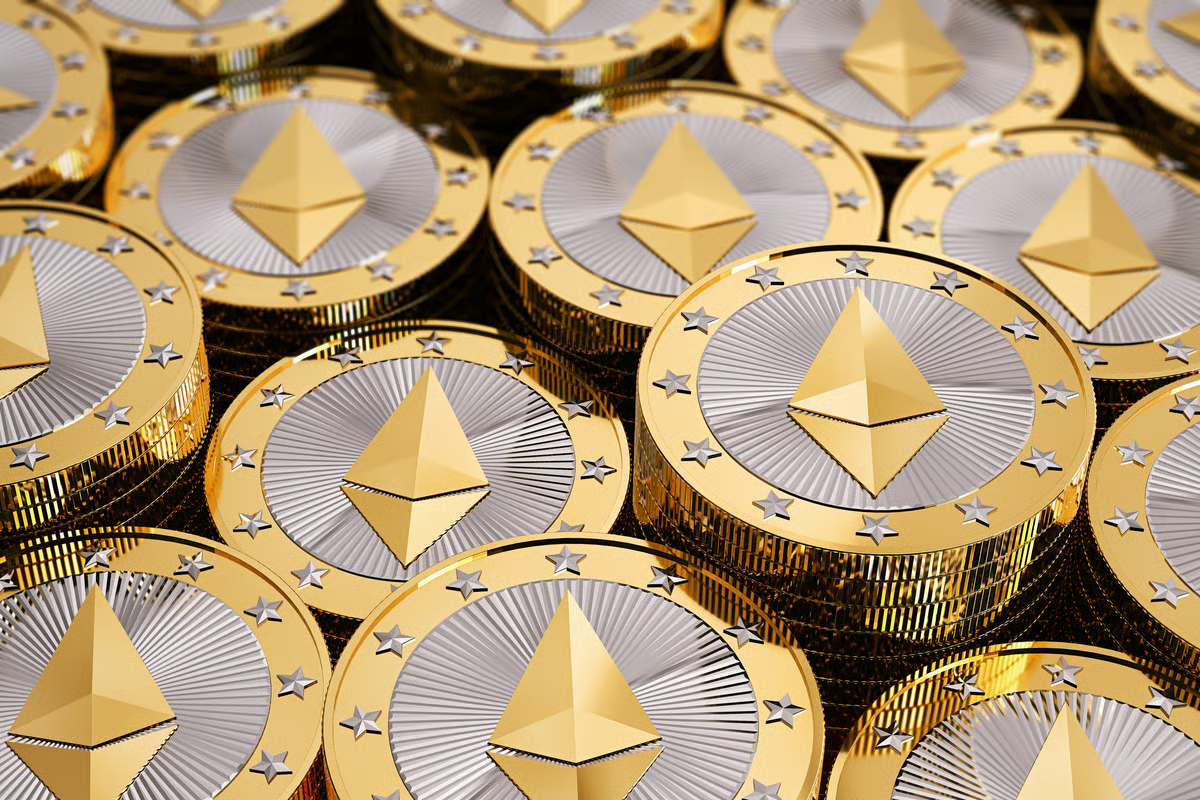
The cryptocurrency Ether, integral to the Ethereum blockchain, has experienced significant value fluctuation this year, dropping over 33% amid a challenging market landscape. Despite these downturns, analysts remain optimistic about Ether’s potential for recovery and substantial growth in the coming years.
Originally mined like Bitcoin, Ether underwent a significant shift in 2022 when it transitioned to a proof-of-stake (PoS) consensus mechanism. This change marked the end of traditional mining for Ether, allowing it to be “staked,” meaning users can lock up their tokens on the blockchain in exchange for rewards. The shift aimed to enhance energy efficiency and has since supported Ether’s capabilities in powering smart contracts and facilitating the development of decentralized applications (dApps), non-fungible tokens (NFTs), and a range of other crypto assets.
Currently, Ether’s value is more closely linked to the growth of its developer ecosystem rather than its scarcity. With a circulating supply of approximately 121 million tokens, Ether lacks a fixed supply limit, unlike Bitcoin. Although its primary Layer 1 (L1) blockchain does not operate as quickly as newer PoS blockchains like Solana, advancements through Layer 2 (L2) rollups are enabling Ether to improve transaction speeds significantly.
As of now, Ether boasts a market cap of around $250 billion, with a trading price of approximately $2,077.27. In the most recent market period, the token’s value fluctuated between a low of $1,756.73 and a high of $2,084.66. Ethereum has also attracted nearly 32,000 active developers, solidifying its position as the largest developer-centered blockchain. Enthusiasts assert that this robust ecosystem will bolster Ether’s price as its integration into decentralized finance (DeFi) applications expands.
Looking ahead, analysts speculate that Ether could experience a significant valuation increase to over $19,000 within the next decade, a tenfold rise from current levels. However, this is seen as a conservative estimate; some forecast even more ambitious targets, such as the $180,000 mark as suggested by prominent investor Cathie Wood.
Factors contributing to these optimistic projections include anticipated improvements to Ethereum’s scalability, reduced network congestion, lower gas fees, and increased efficiency through three upcoming upgrades—The Verge, The Purge, and The Splurge. These enhancements are expected to not only facilitate increased network activity but also strengthen Ether’s competitive position against other PoS blockchains.
Despite the optimistic outlook, Ether’s current price dynamics are influenced by a range of external factors, including uncertain interest rate expectations and broader economic challenges, which may lead to price fluctuations in the near term. As these challenges recede, however, Ether is poised to recover, particularly with the potential introduction of Ether spot price exchange-traded funds (ETFs) that could attract institutional investment.
The combination of a strong developer base, planned technological upgrades, and institutional interest places Ether in a compelling position for the years ahead, leading many to speculate that it may eventually reclaim and surpass its previous highs.