In a candid appearance on Steve Eisman’s “Real Eisman Playbook” podcast, George Noble, a former Fidelity Investments manager renowned for leading the number one mutual fund in America in 1985, expressed his bearish views on key market players, including Tesla and Bitcoin. Noble, who achieved a staggering 79% return during his peak fund management years, didn’t pull any punches while sharing his current market perspectives.
In particular, Noble criticized Michael Saylor, co-founder of MicroStrategy, labeling him a “carnival barker” and asserting that he “should be in jail” due to Saylor’s previous accounting irregularities. This remark came as Eisman revealed his decision to short MicroStrategy stock, which has plummeted from a 52-week high of over $457 to just around $124, following a daunting net loss of $12.4 billion in the fourth quarter.
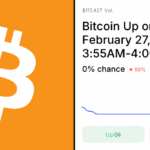
Noble’s skepticism extended to Bitcoin, which he referred to as “the Facebook of speculative assets,” claiming its appeal has shifted towards older investors, dubbed “boomers.” He noted a significant decline in Bitcoin’s value, highlighting that it has fallen approximately 50% from its all-time high of nearly $126,000 in October 2025. Furthermore, market traders currently assign only a 33% chance of Bitcoin rebounding to $100,000 by year-end, reflecting a bleak sentiment around the cryptocurrency.
Both Noble and Eisman echoed concerns over Bitcoin’s recent performance. Eisman remarked that the cryptocurrency seemed to trade against its fundamental principles, often falling during inflation-fueled sell-offs and rising with tech stock rallies.
Noble also expressed disappointment with Tesla’s earnings, which peaked at $4.50 per share in 2022 but fell to around $1.70 in the last year. Despite this decline, Tesla maintains a staggering market capitalization exceeding $1.2 trillion. Noble suggested that the electric vehicle manufacturer could face cash flow issues this year, particularly as its capital expenditures increase while revenues are projected to decline for a third consecutive year. As evidence, Polymarket traders estimate a 77% chance that Tesla will deliver fewer than 350,000 units in Q1, a significant drop of at least 68,000 vehicles.
In contrast to his bearish outlook on tech, Noble posits a significant rotation out of technology investments in favor of energy stocks. He advocates for a long position in the Energy Select Sector SPDR Fund (XLE) while simultaneously shorting the Technology Select Sector SPDR Fund (XLK). As part of his strategy, he highlighted that oilfield services firm SLB, formerly known as Schlumberger, has outperformed tech giant Microsoft by 100% over the past three months. Noble believes the discrepancy between energy’s 3% weighting in the S&P 500 compared to tech’s 35% is unsustainable, indicating we are only at the “first inning” of a broader shift into energy sectors. Among energy stocks, he expressed particular enthusiasm for offshore driller Tidewater.
Both men discussed the current AI landscape, with Noble giving a bearish outlook on the broader AI trade. He cited research suggesting that capital misallocation in AI could be 17 times worse than the dot-com bust. In an interaction with an engineer who utilizes ChatGPT for just $20 a month, Noble pointed out the absence of a compelling reason to switch to more expensive options that don’t demonstrate added value.
While Eisman cautioned against shorting Tesla due to its cult-like following, Noble remained bullish on gold, noting its recent surge to over $5,100, which marks a 65% increase in 2025. He argues that the depreciation of fiat currencies bolsters gold’s appeal as a safe asset. However, Eisman countered this view, asserting that without an alternative to U.S. Treasuries, the relevance of gold as a safe haven is more theoretical than practical.
Overall, Noble’s and Eisman’s discussions shed light on diverging investment philosophies and a potential transition away from technology and cryptocurrencies into energy and alternative assets, as underlying market conditions evolve.