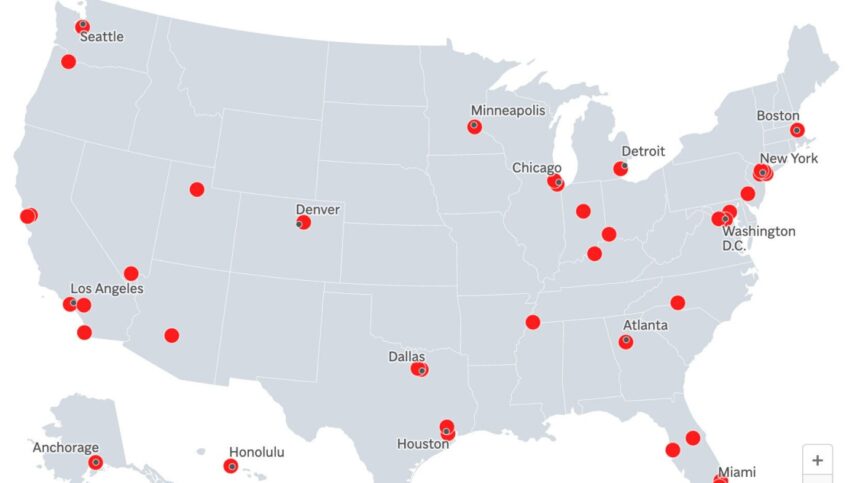
The Federal Aviation Administration (FAA) has announced an unprecedented order that will significantly reduce flight operations across the country due to an ongoing government shutdown. This directive is set to take effect early Friday, impacting 40 airports throughout more than two dozen states, including major hubs such as Atlanta, Dallas, Denver, Los Angeles, and Charlotte, North Carolina.
Airports in metropolitan areas like New York, Houston, Chicago, and Washington, D.C., will experience the most significant disruptions, with the potential for smaller airports to feel the ripple effects of the cuts. In anticipation of the FAA’s order, airlines scrambled to adjust their schedules on Thursday, leading to the cancellation of over 780 flights nationwide, as reported by FlightAware. Delta Air Lines has announced it will cancel around 170 flights on Friday, while American Airlines plans to cut approximately 220 flights daily through Monday.
The FAA’s reductions will begin at 4% and gradually increase to 10% by November 14. These cuts will be in effect daily from 6 a.m. to 10 p.m., affecting all commercial airlines. The agency emphasized that the measures are necessary to alleviate the burden on air traffic controllers, many of whom have been working without pay for over a month. With increasing financial strain and exhaustion, a growing number of controllers have started calling in sick.
Kelly Matthews, a frequent traveler from Flat Rock, Michigan, expressed frustration with the situation, stating, “You can’t expect people to go in to work when they’re not getting a paycheck. It’s not a matter of them not wanting to do the job — but you can’t afford to pay for gas, your daycare, and everything else.”
As the Trump administration intensifies pressure on congressional Democrats to resolve the shutdown, airlines are striving to minimize customer impact. Some carriers have indicated they will prioritize cutting routes to and from smaller cities to mitigate the disruption.
Passengers whose flights are canceled are entitled to refunds, but airlines are not obligated to cover additional expenses such as meals or hotel accommodations unless the delays stem from factors under the airlines’ control, as per the Department of Transportation.
Industry analyst Henry Harteveldt has warned of the broader implications these reductions could have on the U.S. air transportation system. Furthermore, the cuts are expected to affect package delivery services as two airports listed—FedEx’s hub in Memphis, Tennessee, and UPS’s hub in Louisville, Kentucky—serve as critical distribution centers, the latter being the site of a recent deadly cargo plane crash. As the situation evolves, travelers and airlines alike remain on high alert for further developments.