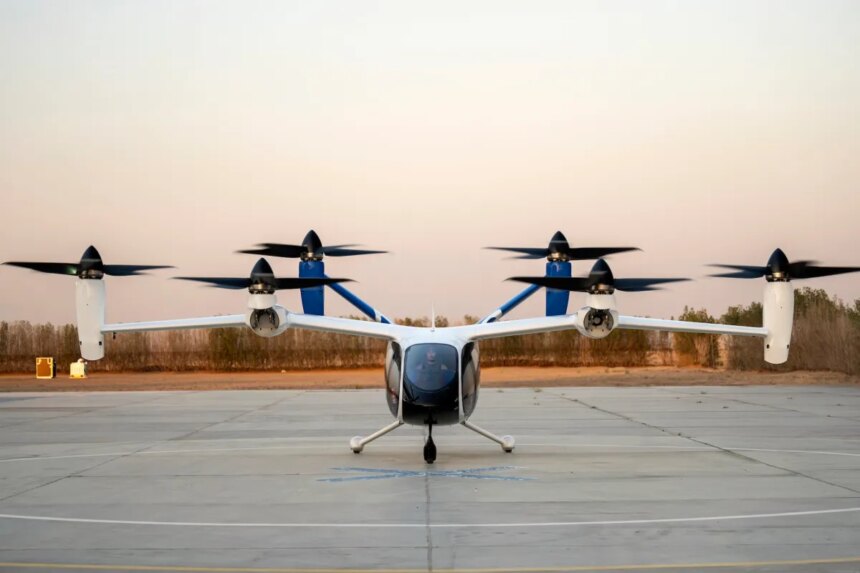
The Federal Aviation Administration (FAA) has granted approval for eight pilot programs aimed at facilitating electric aircraft testing across various companies, including prominent industry players such as Archer Aviation, Beta Technologies, Joby Aviation, and Wisk. This initiative may kick off testing as early as this summer and is set to span a three-year period across 26 states.
Department of Transportation Secretary Sean Duffy announced the program during remarks on Monday, emphasizing that it aims to position U.S. companies at the forefront of advanced aircraft development for diverse applications like personal travel, regional transportation, cargo logistics, and emergency medical services. This pilot program, officially titled the Advanced Air Mobility and Electric Vertical Takeoff and Landing Integration Pilot Program, was introduced last year through an executive order by former President Trump to expedite the evolution of futuristic aircraft.
In recent years, the emergence of numerous electric vertical takeoff and landing (eVTOL) companies has sparked potential for urban air taxis and regional electric aircraft. However, entering commercial operations typically involves a lengthy and expensive process, given that the FAA must certify any new aircraft, which can take several years. The newly approved pilot program allows these companies to begin testing their eVTOL models prior to having full regulatory certification.
The expedited timeline is expected to enhance the operational prospects and stock valuations of many eVTOL firms, including Archer, Beta, and Joby, which have recently gone public. Notably, Beta Technologies’ founder and CEO Kyle Clark remarked that being selected for this program enables the company to launch operations one year earlier than initially planned, a development reflected in a nearly 12% rise in the company’s stock price. Archer and Joby also experienced significant stock increases following the announcement.
Archer Aviation has drawn parallels between this eVTOL initiative and ongoing robotaxi trials, indicating that it will foster public trust and create a framework for safely scaling electric air taxi services. The company is working on a four-passenger piloted eVTOL named Midnight, which they aim to integrate into operations in Los Angeles ahead of the 2028 Olympic Games.
FAA Deputy Administrator Chris Rocheleau noted that the partnerships formed through this pilot program will enhance understanding of how to safely and effectively incorporate eVTOL aircraft into the National Airspace System. He acknowledged the strong interest in the initiative, with 30 proposals received by the FAA.
Collaboration is integral to the program, as it mandates partnerships with state, local, tribal, or territorial governments. The projects will explore various applications of electric aircraft, including urban air taxis and regional flights. For example, the Port Authority of New York and New Jersey is working with Archer, Beta, Electra, and Joby to test operational concepts from a Manhattan heliport. Additionally, the Texas Department of Transportation is partnering with the same companies to explore regional flights connecting major cities like Dallas, Austin, San Antonio, and Houston.
Some pilot projects have expansive geographic implications, such as a Utah-led initiative aimed at testing next-generation aircraft across the Pacific Northwest, the Rocky Mountains, and the Plains of Oklahoma. Likewise, a Pennsylvania Department of Transportation project will involve 13 states to revitalize regional flight services nationwide.
There is also focus on cargo delivery and medical response initiatives, with companies like Beta and Elroy Air testing transportation flights in the Gulf of Mexico and energy sectors across Louisiana, Texas, and Mississippi. Furthermore, projects led by the departments of transportation in Florida, Louisiana, and North Carolina are underway, alongside collaboration between the city of Albuquerque and Reliable Robotics to explore autonomous operations.