The Atlanta Falcons find themselves at a critical juncture following a disappointing NFL season. After starting strong with a 3-2 record, including a memorable win against the Buffalo Bills in Week 6, the team plunged into disarray. With five consecutive losses, their record has dwindled to 4-9, leading to their official elimination from playoff contention as of last Sunday.
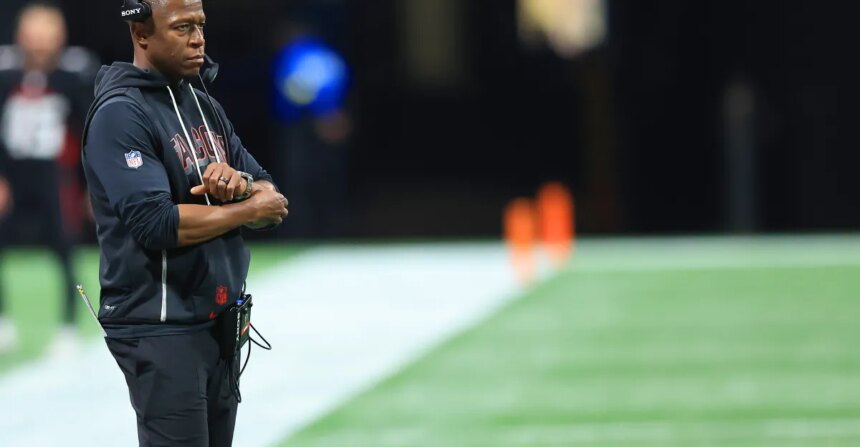
This decline raises significant questions about the future of head coach Raheem Morris, who was brought on board to turn around a franchise that has consistently underperformed in recent years. Morris, who made headlines as one of the youngest head coaches in NFL history, had promised a new direction for the team. However, the alarming trend of poor performance has left many to wonder if he is the right leader to guide the franchise moving forward.
The NFC South remains competitive, with the 7-6 Carolina Panthers currently at the top. Given this opportunity, Atlanta only needed a handful of wins to potentially seize the division title, but their continued struggles have deemed that goal unattainable. Fans and analysts alike are now scrutinizing the coaching staff, particularly the decisions made regarding coordinators and game management.
Morris, opting for a “CEO” approach, delegated offensive and defensive play-calling responsibilities to rookie coordinators—Zac Robinson and Jimmy Lake—while he focused on higher-level management. Unfortunately, this strategy has led to significant issues. Morris’s inexperience in managing all three game phases has become increasingly evident as the season has progressed.
Nearly every aspect of the Falcons’ gameplay has suffered under Morris’s leadership. The team has exhibited a glaring lack of strategic execution, particularly on offense. The struggles continued with Robinson’s adaptation as the offensive coordinator, who, despite starting the season decently, became increasingly predictable and stale as the year unfolded. Robinson’s failure to adapt has been compounded by defensive collapses, most notably under Lake, whose complicated schemes appeared unfriendly to players, leading to widespread confusion and frustration.
In a series of decisions that may haunt the franchise for years, Morris has made several questionable coordinator hires. Zac Robinson’s learning curve as a first-time offensive coordinator has not resulted in development, while Lake is likely to be shown the door after the season. Marquice Williams, retained as the special teams coordinator, has also seen his unit fall to the bottom of the league, straining the Falcons’ chances for success.
Morris’s management style has led to tumultuous relations within the coaching staff. The firing of well-regarded wide receivers coach Ike Hilliard just weeks into the season lowered morale and diminished the offensive unit’s productivity. Despite Hilliard’s early success in developing talent, the decision to part ways with him illustrates deeper issues regarding communication and management within the organization.
The overarching failures do not stop with coaching. Roster decisions, reportedly made collaboratively with general manager Terry Fontenot, have also raised eyebrows. Notable missteps, such as signing Kirk Cousins alongside rookie Michael Penix Jr. while allowing key players like center Drew Dalman to leave, have seriously hampered Atlanta’s on-field performance.
Game management under Morris is another area of concern. Consistently poor use of timeouts and questionable decision-making in crucial game moments have cost Atlanta dearly. Their record in one-score games highlights these issues, with the team struggling significantly in high-pressure situations.
As the Falcons approach a potential coaching reset heading into the 2026 season, the crucial question remains: Can Morris lead the team back to viability? With his track record showing little promise, many believe that change is imperative. Arthur Blank, the team owner, is faced with a tough choice that could redefine the future of the franchise. Keeping Morris for a third season would require a leap of faith based on a timeline that has not yielded the expected improvements.
Ultimately, the franchise’s direction is uncertain as it grapples with a frustrating campaign. The Falcons are in dire need of a transformative decision that could restore competitiveness and mediocrity. As it stands, the data suggests that Morris has been unable to elevate the Falcons from their cyclic struggles, signaling that a change may well be in order.