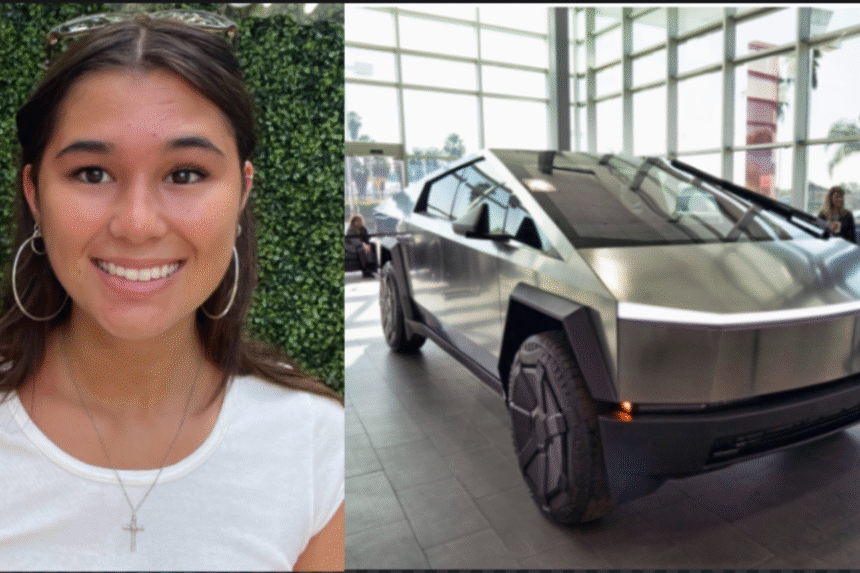
The family of a college student who died in a tragic Cybertruck accident is taking legal action against Tesla, alleging that the vehicle’s door design constitutes a “death trap.” Krysta Tsukahara, just 19 years old and a student at the Savannah College of Art and Design, lost her life alongside two others when their Cybertruck collided with a tree in Piedmont, California, in November 2024. reports suggest that Tsukahara was trapped in the backseat when the vehicle caught fire, unable to locate the manual door release mechanisms outlined in the owner’s manual.
According to the lawsuit, the electronically powered doors fail to provide a functional fallback option for emergency egress when the power is lost. In an emergency situation, a passenger in the rear seat must dig through the door’s pocket to access the release, a process deemed convoluted and perilous in dire circumstances. The filing argues that the Cybertruck “lacked a functional, accessible, and conspicuous manual door release mechanism, fail-safe, or other redundant system for emergency egress.”
Krysta’s parents, Carl and Noelle Tsukahara, are seeking damages from Tesla, owned by billionaire Elon Musk. Carl expressed deep frustration over their loss and questioned how a trillion-dollar company could release a vehicle that poses such significant safety risks. “We’ve had to endure not only the loss of our daughter, but the silence surrounding how this happened and why she couldn’t get out,” he stated.
Witness accounts describe the harrowing scene. Matt Riordan, a friend who witnessed the crash, attempted to help by smashing the front window with a tree branch after the Cybertruck erupted in flames. He managed to rescue the front-seat passenger but could not free Tsukahara before the fire engulfed the vehicle.
Both Tsukahara and her fellow passengers, Soren Dixon, 19, and Jack Nelson, 20, tragically lost their lives in this accident. Following this incident, Nelson’s family also filed a lawsuit against Tesla. The Nelson family’s complaint highlights that the design defects of the Cybertruck exacerbated a potentially survivable crash, turning it into a fatal situation.
The controversy surrounding Tesla’s door designs has spurred federal inquiries, with the National Highway Traffic Safety Administration (NHTSA) investigating door locks on various Tesla models, including the Model Y. Regulators are particularly concerned about the inability to open doors from outside when electronic systems fail, an issue that raises serious safety concerns.
In response to the backlash, Franz von Holzhausen, Tesla’s chief designer, affirmed that the company is actively working on new door designs to mitigate these risks. He noted on a podcast that the company is taking steps to ensure greater accessibility during emergencies.
The Tsukahara lawsuit claims that Tesla had prior knowledge of the risks associated with its electronic door systems but failed to act. The suit states that Tesla had been alerted numerous times about entrapment incidents, where occupants survived the force of crashes but could not escape during electrical failures or fires.
Earlier this year, the Tsukaharas also filed a wrongful death lawsuit against the estate of the driver, Soren Dixon, citing toxicology reports that indicated Dixon had drugs and alcohol in his system at the time of the accident, contributing to the harrowing scenario.
The broader conversation surrounding automobile safety, especially in electric vehicles, is igniting urgent discussions about regulatory standards and corporate responsibility in product design—raises significant awareness and questions about the importance of accessible safety features in vehicles designed for a modern era.