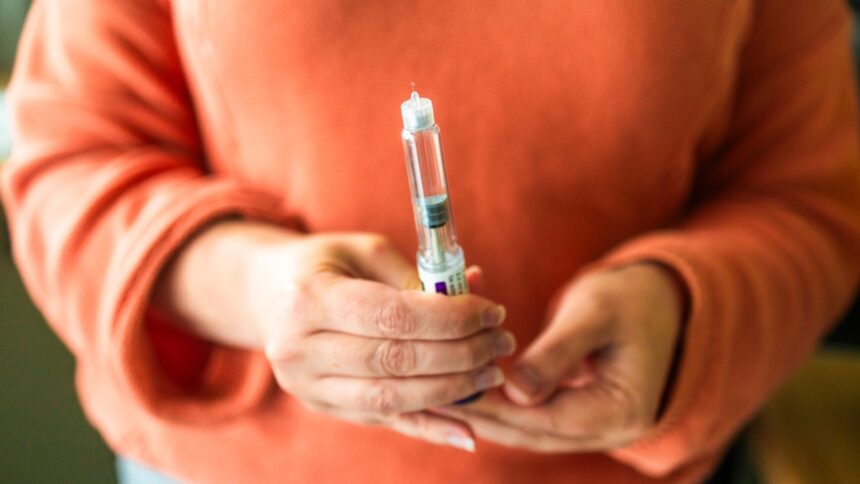
Federal regulators have authorized a new, higher-dose version of Wegovy, a leading obesity medication, which promises enhanced weight loss benefits for users. The U.S. Food and Drug Administration (FDA) approved a 7.2-milligram dose of the semaglutide drug, produced by Danish pharmaceutical company Novo Nordisk. Previously, the maximum approved dosage for Wegovy was 2.4 milligrams, taken as a weekly injection.
This new formulation went through the FDA’s expedited review process, receiving approval just 54 days after the review request was accepted. Set to hit U.S. pharmacies in April, the pricing details will be disclosed closer to its release date. Europe saw its version of the higher-dose Wegovy approved in February.
Clinical trials for the higher dose, referred to as Wegovy HD, demonstrated promising results, with participants achieving an approximate weight loss of 19%—equivalent to nearly 47 pounds—over nearly 17 months. In contrast, users of the previous 2.4-milligram dosage experienced an average weight reduction of about 16%, or 39 pounds.
The development of the higher 7.2-milligram dose stems from the acknowledgment that not all patients achieve their desired weight loss with the lower dosage, as documented in a study published in the journal Lancet Diabetes & Endocrinology last year. The FDA also approved an oral variant of Wegovy in December, containing 25 milligrams of semaglutide, aimed at ensuring absorption through the digestive system.
Experts are optimistic about the new dosage’s potential. Dr. Jody Dushay, an endocrinologist and obesity specialist at Harvard Medical School, expressed that this higher dose may be particularly beneficial for those who have found limited success with the lower dosage. It could also assist individuals who do not respond well to Eli Lilly’s obesity drug, Zepbound.
However, the higher dose is not without its challenges. Clinical trials indicated that side effects such as nausea, vomiting, and constipation were reported in over 70% of those using the 7.2-milligram dose, compared to more than 60% for the lower dose and around 43% for a placebo. Additionally, an uncomfortable skin condition characterized by sensations of burning or stabbing affected about 23% of participants on the higher dose versus 6% on the lower dose and less than 1% of those receiving a placebo.
Serious adverse events occurred in nearly 7% of participants taking the higher dosage, compared to 11% for the 2.4-milligram group and 5% for the placebo group. Dr. Dushay noted the significant increase from 2.4 milligrams to 7.2 milligrams without an intermediate option and highlighted the importance of observing real-world side effects as opposed to those recorded in controlled trials.