Recent movements in the market have been significantly influenced by the Federal Reserve’s decision to cut interest rates, leading to intensified speculation regarding future monetary policy. Experts had largely anticipated a reduction, but it was the accompanying commentary from Fed policymakers that spurred notable market shifts, indicating that additional rate cuts may be forthcoming. This prospect has had a positive effect on various sectors, notably boosting the demand for gold and other precious metals.
The cryptocurrency sector also experienced a surge in initial market capitalization following the announcement, although it faced a subsequent correction. Blockchain miners have emerged as primary beneficiaries of the potential dovish stance from the Federal Reserve, with Riot Platforms (NASDAQ:RIOT) leading the charge after a substantial rally.
In the midweek trading session, Riot’s stock saw an increase of over 5%, briefly pushing its price beyond the psychologically significant $20 milestone. Analysts consider this level a reasonable target for further movement in the near term. In contrast, rival company Canaan (NASDAQ:CAN) enjoyed a notable upswing of nearly 13%, while MARA Holdings (NASDAQ:MARA) experienced a modest rise of over 1%. Nonetheless, Riot has distinguished itself with a remarkable 35% gain over the past month, making it a standout performer in this competitive landscape.
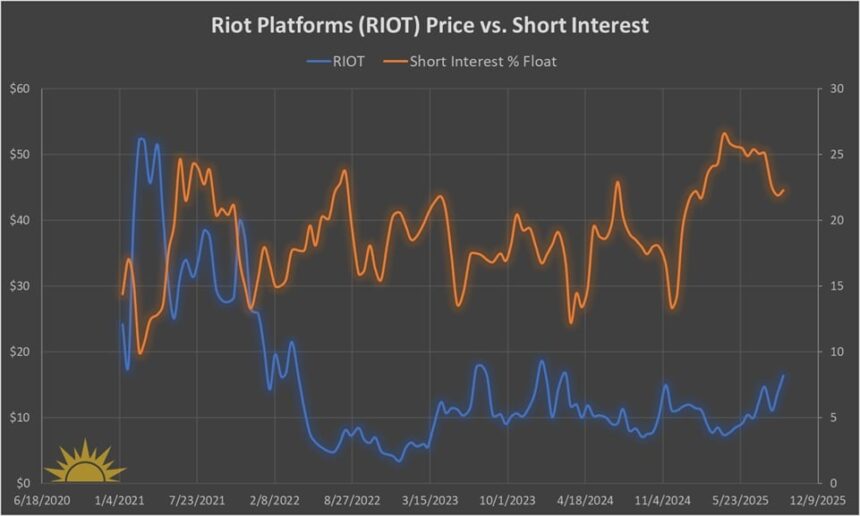
The key question for investors now is whether Riot’s stock can sustain its upward trajectory. Much of the excitement surrounding RIOT stock may hinge on a potential short squeeze, as current estimates suggest that approximately 22.28% of its float is sold short. This high level of short interest indicates that a considerable portion of Riot’s publicly available shares has been sold, creating a situation where those borrowing shares must eventually return them to brokers, regardless of stock performance.
For those betting against the stock, a decline in its value could yield profits when reacquiring shares at a lower price; however, an increase in the stock price would create uncapped losses for these short sellers, fueling a potential short squeeze. Historical data reveals that from January 2021 to early September 2025, the correlation between RIOT stock and short interest was relatively weak, with a coefficient of -29.75%. Yet, since April of this year, this relationship has intensified, with a coefficient of -72.17%, suggesting a stronger inverse correlation.
If bearish speculators decide to liquidate their short positions, this could exert upward pressure on RIOT stock. Given the existing high short interest, there could be further potential for price appreciation. However, it is crucial to note that the current days-to-cover ratio stands at only 2.11 days, indicating that any bearish positions could be closed relatively swiftly.
As market dynamics continue to evolve, investors will be closely watching Riot Platforms and similar stocks for further developments, particularly as hints of future monetary policy unfold.