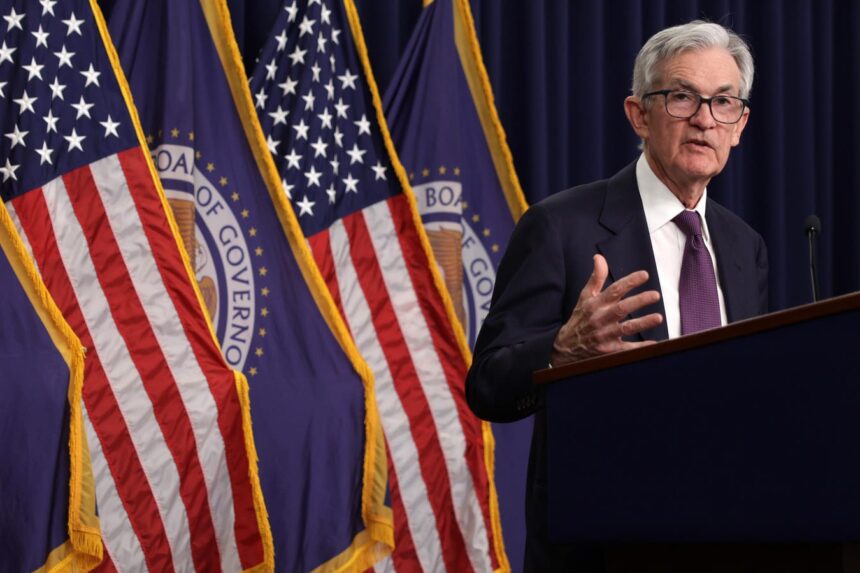
Federal Reserve Board Chairman Jerome Powell addressed media at a pivotal press conference following a two-day Federal Open Market Committee (FOMC) meeting, where the Fed announced a quarter-point interest rate cut, bringing the benchmark rate to a range of 4.25% to 4.5%. This marks the first reduction since December 2024, yet the broader implications of this decision underscore a troubling narrative regarding the Fed’s recent monetary policy trajectory.
Amidst various challenges, market observers have increasingly questioned the robustness of the economic data that underpins the Fed’s decisions, particularly in light of a dwindling labor market and revisions to job growth figures from the Bureau of Labor Statistics (BLS). Key indicators, such as the disappointing August jobs report, have raised concerns about the reliability of the data used by the Fed to gauge economic performance.
The Fed finds itself at a critical junction, grappling with inconsistent signals stemming from existing tariff and trade policies under the Trump administration. While these tariffs, designed to increase import costs, threaten inflation by pressing businesses to raise their prices, they simultaneously sow uncertainty across global supply chains. This situation hinders business investment and dampens hiring prospects, creating a delicate balancing act for the Fed. Should it lower rates to invigorate a faltering economy or hold steady in the face of potential inflation stemming from tariffs?
Despite the emphasis on the Nonfarm Payrolls (NFP) report historically being a key economic metric, the current landscape suggests that tariff policies also significantly influence the Fed’s decision-making. Most recent reports indicate a slight month-on-month decline in producer prices, in contrast to an annualized increase—a sign that while inflation may be on the horizon, it is not a pressing concern at the moment.
The labor market appears weaker than earlier portrayed, with significant revisions from BLS indicating a cumulative loss of 1.7 million jobs over a two-year assessment period. Such revisions cast doubt on the Fed’s aggressive stance on interest rate hikes in light of previously inflated perceptions of a strong labor market. If policymakers had access to accurate employment figures, they might have adopted a more cautious approach, avoiding exacerbation of current labor challenges.
Moreover, the dynamics between public and private sector job creation have shifted notably. Recent BLS data indicates that nearly half of all job growth has emerged from the public sector, contrasting sharply with historical trends that favored private-sector expansion. Concurrently, the rise of gig work has transformed employment patterns. Freelancers and independent contractors now account for a substantial portion of the workforce, indicating a shift towards more flexible employment arrangements.
This evolving landscape signals a need for the BLS to modernize its workforce data collection methods. Relying heavily on outdated survey processes has resulted in significant inaccuracies and lags that affect how economic conditions are assessed. Embracing data analytics and artificial intelligence could provide a more immediate and accurate depiction of labor market trends. By integrating various federal and state data sources, the BLS could furnish policymakers with an enhanced understanding of employment dynamics, thereby improving monetary policy execution.
The FOMC’s interest rate decision today is not merely a response to current economic indicators; it highlights the necessity for reform in how economic data is gathered and interpreted. As the workforce landscape continues to evolve, adopting a more integrated and real-time data approach will enable the Fed to navigate future economic uncertainties with greater assurance and precision.