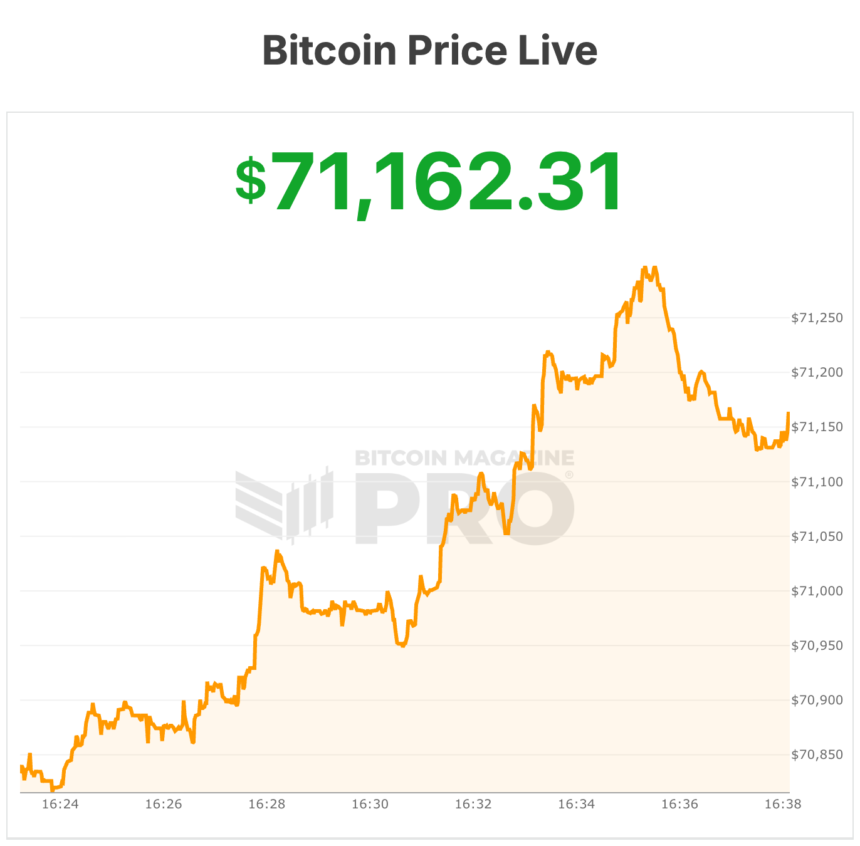
The Federal Reserve decided to keep its benchmark interest rate unchanged, maintaining the federal funds target range at 3.50% to 3.75%. This marks the second consecutive FOMC meeting in which borrowing costs have remained steady, following a pause after three rate cuts last year. Amidst this backdrop, Bitcoin is struggling to maintain a price around $70,000 as various economic challenges persist, including elevated inflation, slowing job growth, and ongoing geopolitical tensions in the Middle East.
As a direct response to the Fed’s announcement, the price of Bitcoin experienced a decline, trading around $70,500, which represents a 3.6% drop over the previous 24 hours. Just last week, Bitcoin had peaked near $76,000, its highest level in over a month. Investors are now reassessing their positions in light of recent inflation data and the complexities of global economic conditions.
During the meeting, the Federal Open Market Committee (FOMC) displayed a divided stance, with eleven members favoring a steady rate while Fed Governor Stephen Miran dissented, calling for a 25-basis-point cut. The FOMC’s statement pointed out that inflation remains elevated and job gains are sluggish, with the unemployment rate having risen to 4.4% in February. This signals a data-driven approach to future rate adjustments, indicating that any forthcoming decisions will depend heavily on upcoming economic indicators.
The decision comes against the backdrop of rising energy prices, exacerbated by the conflict involving the U.S., Israel, and Iran. On Wednesday, Bitcoin’s price fell alongside U.S. stocks following reports of an Israeli military strike on the South Pars gas field in Iran. The FOMC acknowledged the uncertainties regarding the economic implications of the Middle East conflict, stating, “Uncertainty about the economic outlook remains elevated.”
Federal Reserve Chair Jerome Powell addressed the potential consequences of rising energy prices during a press conference. He noted an increase in near-term inflation expectations, likely driven by substantial oil price hikes due to supply disruptions in the region. Powell emphasized that it is “too soon to know” the broader economic impact and confirmed that policymakers will continue to monitor incoming data closely.
He also referenced the influence of tariffs on consumer prices, revealing that a significant portion of price increases can be attributed to these tariffs. Powell described the current federal funds rate range as neutral and reiterated the importance of maintaining central bank independence: “Independence is what allows us to do our jobs, and stable prices is half of our mandate.”
Historically, Bitcoin and other cryptocurrencies have been sensitive to shifts in interest rate expectations, as lower rates often enhance their attractiveness compared to traditional assets. Analysts point out that the interplay of rising energy costs, persistent inflation, and geopolitical risks is leading investors to be more cautious, reducing exposure to riskier assets like Bitcoin.
Oil prices surged on Wednesday, with Brent crude climbing 3.8% to $107.38 per barrel in the wake of the reported attack on the South Pars field. Despite the recent pullback, Bitcoin remains above the $70,000 mark and has seen a weekly gain of 1.6%. Traders are attentively watching for any signals from Powell or the Federal Reserve that could impact future monetary policy decisions.
As Powell’s term as Fed Chair approaches its conclusion in May, the possibility of former Fed Governor Kevin Warsh taking the helm looms if he is confirmed. Powell has stated, “I have no intention of leaving the board until the investigation is well and truly over, with transparency and finality.” At the time of reporting, Bitcoin was trading slightly above $71,000.