Several Federal Reserve officials have recently expressed concerns regarding the elevated valuations of the stock market. The S&P 500, which has surged by 16% in 2025, is experiencing its third consecutive year of robust double-digit returns. However, experts caution that this upward trend might face challenges in 2026, particularly given that midterm election years generally pose difficulties for investors, and current valuations are high by historical standards.
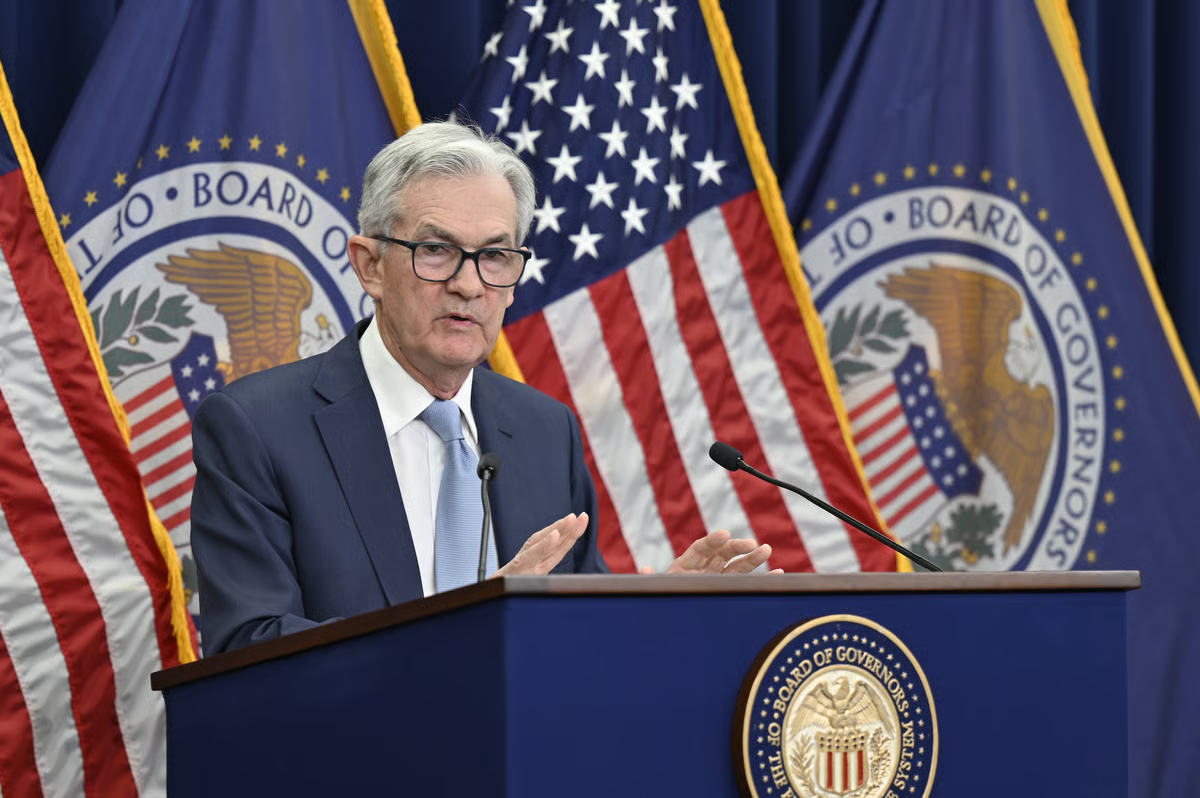
Federal Reserve Chairman Jerome Powell has highlighted this concern, stating, “By many measures… equity prices are fairly highly valued.” Since his remarks in September, the S&P 500 has continued to rise, with valuations now stretched even further, making it one of the most expensive indexes in history.
Historically, the stock market has not fared well during midterm election years. Since the inception of the S&P 500 in 1957, the index has returned an average of merely 1% during the 17 midterm election cycles, compared to an annual average of 9% over the same period. Furthermore, during years when a new president enters office, the S&P 500 has typically declined by an average of 7%. This trend is largely attributed to policy uncertainty that arises around midterms, as the political party in power often loses congressional seats, leading to investor hesitance about the economic agenda.
However, it is worth noting that this uncertainty tends to dissipate quickly. Historically, the period immediately following midterm elections—November through April—has been the strongest in the four-year presidential cycle, with the S&P 500 returning an average of 14% during that timeframe, according to Carson Investment Research.
In addition to Powell, other Fed officials, including Governor Lisa Cook, have issued warnings about the market’s inflated valuations. Minutes from the recent Federal Open Market Committee (FOMC) meeting revealed that several participants expressed concerns over “stretched asset valuations,” with some anticipating a potential disorderly decline in equity prices. Cook specifically emphasized the increased risk of sizeable asset price declines, referencing the central bank’s Financial Stability Report, which indicates that the forward price-to-earnings (PE) ratio of the S&P 500 is nearing the upper bound of its historical range.
As per Yardeni Research, the current forward PE multiple of the S&P 500 stands at 22.2, which is significantly higher than the 10-year average of 18.7. Historically, the index has only traded above 22 during three previous instances, each followed by sharp market declines.
-
Dot-com bubble: In the late 1990s, as investors poured money into speculative internet firms, the forward PE ratio crossed 22. The S&P 500 subsequently plunged 49% from its peak by October 2002.
-
COVID-19 pandemic: The forward PE ratio again exceeded 22 in 2021, leading to an overestimation of the market’s stability in the face of supply chain disruptions. The S&P 500 fell 25% from its highs by October 2022.
-
Trump’s election: In anticipation of President Trump’s reelection in 2024, the forward PE ratio rose above 22. This did not account for the market’s volatility resulting from his tariffs, culminating in a 19% drop from the highs by April 2025.
While a forward PE ratio over 22 does not guarantee a market crash, it historically precedes significant declines. Coupled with the S&P 500’s past performance during midterm election years, these factors suggest that the stock market may face substantial hurdles in 2026.