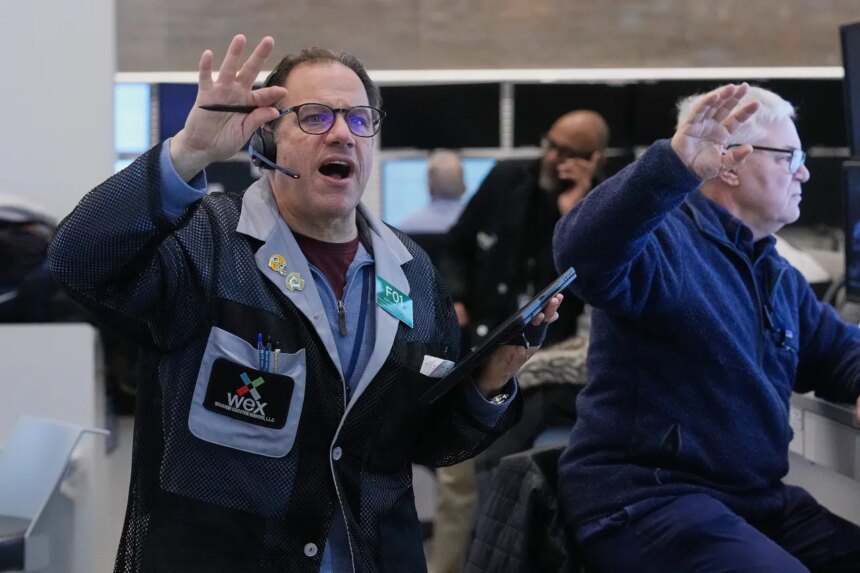
Financial markets experienced turbulence on Friday as investors processed the implications of President Donald Trump’s nomination of Kevin Warsh to lead the Federal Reserve. The uncertainty surrounding this nomination influenced trading, resulting in declines across major U.S. stock indices. The S&P 500 fell by 0.4% after facing a sharper drop of 1.1% earlier in the trading session. The Dow Jones Industrial Average decreased by 179 points, also down 0.4%, while the Nasdaq composite lost 0.9%.
In currency markets, the value of the U.S. dollar saw fluctuations, initially swaying before ultimately rallying following Warsh’s nomination. Precious metals markets, which had previously enjoyed a stellar period, faced sharp declines, with gold and silver prices plummeting after reaching significant highs over the past year.
The person who leads the Fed holds considerable influence over both the economy and global financial markets by steering the U.S. central bank’s interest rate decisions. These decisions are crucial as they can either stimulate the economy or curb inflation. Trump has been advocating for lower interest rates, which tend to encourage economic growth but also contribute to rising inflation.
Concerns have been mounting in financial circles about the potential erosion of the Fed’s independence under Trump’s influence. This apprehension had previously led to a surge in gold prices and a decline in the U.S. dollar. The longstanding belief in market circles has been that the Fed should operate independently from political pressures. This independence is vital for making potentially unpopular decisions, such as maintaining high interest rates to achieve an inflation goal of 2%, even at the risk of slowing economic growth.
As analysts dissect the implications of Warsh’s nomination, which still requires Senate confirmation, questions loom regarding the Fed’s independence. Warsh’s prior experience as a governor on the Fed’s board gives him a level of familiarity that investors may find reassuring. However, his criticisms of the Fed’s bond-buying strategies to maintain low interest rates suggest a nuanced position.
Market responses to Warsh’s nomination have been mixed. Some analysts see it as a positive signal for an independent Fed that may be inclined to maintain higher interest rates if required. Conversely, Warsh’s history of supporting lower rates raises doubts about his future actions. Thierry Wizman, a strategist at Macquarie Group, noted that while Warsh is closely aligned with Trump on monetary policy, this alignment does not necessarily imply immediate rate cuts.
The stock market felt the pressure of falling metal prices, significantly impacting miners. Gold prices on Friday dropped 11.4%, settling at $4,745.10 per ounce, a stark decline after a year-long rally that saw prices nearly double. Silver experienced an even more drastic fall of 31.4%. The pricing plunge was perceived as a correction after an extraordinary run, as investors sought to hedge against various economic uncertainties, including tariff threats and significant global debt levels.
Consequently, shares of mining companies suffered; Newmont’s stock fell by 11.5%, and Freeport-McMoRan saw a decline of 7.5%. On the brighter side, auto manufacturer Tesla saw its shares rise by 3.3%, rebounding after a previous drop, thanks to better-than-expected quarterly profits. Apple also gained 0.5% following a strong earnings report.
Overall, the S&P 500 concluded at 6,939.03, with a drop of 29.98 points, while the Dow Jones Industrial Average finished at 48,892.47, down 179.09 points. The Nasdaq composite closed at 23,461.82, down 223.30 points.
In the bond market, the yield on the 10-year Treasury climbed slightly to 4.25% from 4.24% the previous day. Initial gains in the yield had reached near 4.28% during overnight trading before settling back down. Rising yields can signal weakening bond prices and could indicate growing pressure on the Fed to maintain interest rates in light of a recent report showing higher-than-expected wholesale inflation.
International stock markets showed a more optimistic trend, with several European indexes rising, following a mixed performance in Asia. Indonesian stocks rebounded by 1.2% after the resignation of the CEO of the Indonesian stock market, following earlier concerns raised by MSCI about market risks.