As the stock market grapples with recent corrections, investors are flocking to well-established mega-cap blue-chip companies known for their diversified business models and strong brand moats. While this strategy often proves effective, analysts suggest it may already be reflected in the current valuations of technology stocks. Instead, the most promising opportunities within the Nasdaq Composite’s recovery might lie in stocks that are unjustly undervalued yet poised to harness the long-term growth potential of artificial intelligence (AI).
One notable player in the semiconductor sector, often overshadowed by giants like Nvidia, is Marvell Technology. As hyperscalers such as Alphabet, Amazon, and Microsoft increasingly develop their own custom AI chips, Marvell finds itself strategically positioned at the crossroads of two significant trends: custom ASIC design and optical interconnects. Interestingly, the company’s data center revenue isn’t directly tied to AI spending, but rather depends on the evolving nature of AI budgets and the necessary architectures as various use cases become operational.
Marvell’s growth trajectory appears strong due to the ongoing expansion of AI infrastructure, offering structural advantages regardless of which models or chip designs ultimately dominate the market. Recent trade data indicates a notable increase in Marvell’s share price, rising by 7.93% to reach $129.38, with a market capitalization of $105 billion. This upward movement reflects a growing recognition of its potential in the sector.
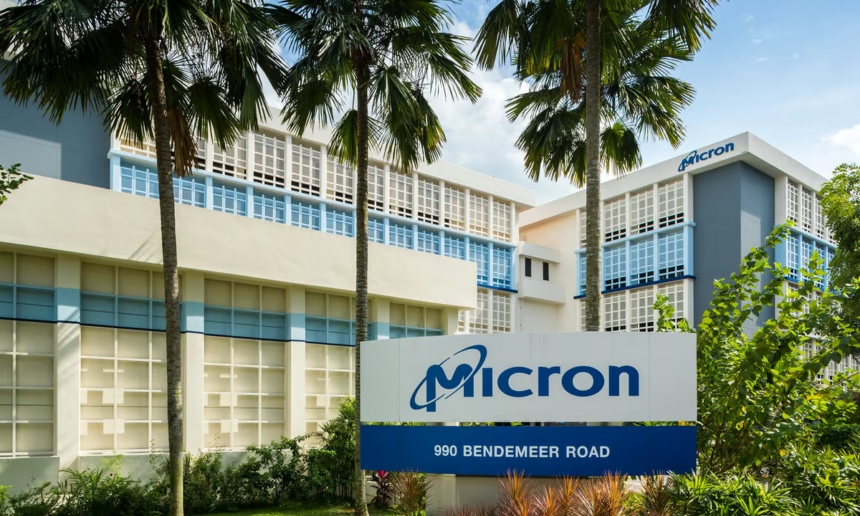
In a different aspect of the AI conversation, Micron Technology presents an intriguing case. Traditionally viewed as cyclical, Micron’s AI-related revenue is often underestimated, treated more as a supplementary aspect than a foundational element. As AI workloads continue to expand, the demand for semiconductor memory—particularly high-bandwidth memory (HBM)—is shifting, highlighting a significant departure from conventional memory profiles.
Despite being labeled cyclical, Micron’s valuation compression may create an opportunity. The increasing need for DRAM and NAND chips amidst a growing AI landscape is expected to solidify a durable floor beneath its business. Current trading shows a modest increase of 0.31% in Micron’s share price, which is now at $422.82, allowing it to maintain a robust market cap of $475 billion. Notably, if the Nasdaq experiences a rebound by year’s end, Micron could see a sharper recovery due to its dual discount: once for its cyclical characteristics and again for broader macroeconomic concerns.
Meanwhile, Broadcom stands out in the semiconductor field for its resilience and long-term contracts in the AI sector. While not often mentioned alongside Nvidia, the company boasts a remarkably stable AI profile, thanks to its partnerships with major hyperscalers engaged in custom ASIC development. Broadcom’s focus on networking and software, coupled with its commitment to data center revenue, creates a steady cash flow that remains largely insulated from the fluctuations of the AI cycle.
Recent gains of 5.38% in Broadcom’s share price bring it to $373.99, contributing to an impressive market cap of $1.7 trillion. This consistency positions Broadcom as a “platform compounder” that could benefit significantly from a market rebound, as investors are likely to reassess its value after indiscriminately selling off shares during recent corrections.
As the market continues to navigate a complex landscape, opportunities may increasingly reside in identifying undervalued companies linked to AI, rather than solely following the well-trodden paths of more familiar giants. Recognizing the potential for recovery in these overlooked stocks could prove to be a game-changing strategy for investors looking to capitalize on the AI-driven future.