



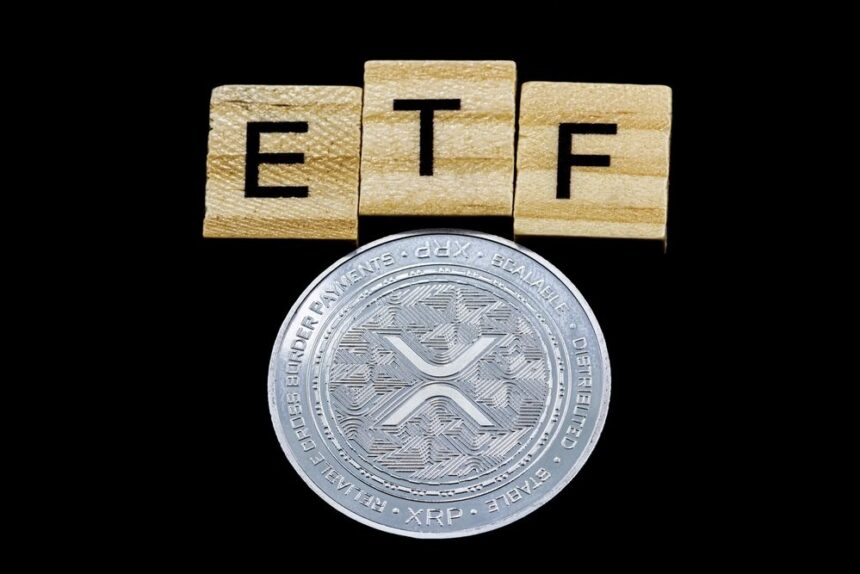
The landscape surrounding XRP exchange-traded funds (ETFs) is heating up, with market analyst Ripple Bull Winkle highlighting the potential influence of Franklin Templeton, a major player in the global asset management sector with $1.6 trillion in assets under management. Following the successful launch of Canary Capital’s XRPC ETF, which secured $58 million on its first day, speculation is rife around what the entry of a financial juggernaut like Franklin Templeton could achieve in this burgeoning market.
Winkle points out that the firm’s ongoing expansion in digital asset strategies and recent activity on blockchain platforms signals a growing interest in digital financial products. Historically, Franklin Templeton has positioned itself as a pioneer in tokenized assets and blockchain investment vehicles. An XRP ETF could be a logical progression, especially given the rising institutional demand for diverse cryptocurrency exposure.
If a smaller entity like Canary Capital can attract $58 million on its inaugural day, the possibilities for Franklin Templeton are amplified by its significant resources, including deep liquidity and extensive global distribution networks. The firm’s presence would not only draw substantial inflows but could also catalyze widespread movement of capital across the market.
Winkle emphasizes that the favorable regulatory environment for XRP in the U.S., alongside its demonstrated utility for cross-border transactions, makes it ripe for institutional products. A Franklin Templeton ETF could further legitimize XRP as a viable institutional asset, similarly to how Bitcoin and Ethereum ETFs have fueled mainstream appeal.
Moreover, beyond the legitimization of XRP, the market’s psychological dynamics could see a massive shift if Franklin Templeton were to launch an XRP ETF. Large institutional investors typically influence market perceptions, and such a move would convey to industry leaders like BlackRock, Fidelity, and Invesco that XRP offerings are not merely feasible but increasingly competitive.
Looking ahead, an approved ETF from Franklin Templeton by November 18 could stimulate derivatives markets, pave the way for new structured financial products, and increase XRP’s integration into wealth management strategies. This scenario suggests that the introduction of an additional ETF would not just be a routine market development; it could significantly advance institutional acceptance of XRP on a global scale.
In conclusion, if Franklin Templeton proceeds with an XRP ETF, it could represent a critical turning point for institutional cryptocurrency adoption. The initial spark lit by Canary’s $58 million entry could pale in comparison to the potential tidal wave of capital redistribution initiated by a trillion-dollar asset manager. If successful, this ETF could validate XRP’s position in the financial landscape and facilitate unprecedented levels of institutional investment, transforming it from a speculative asset into a mainstream financial instrument.