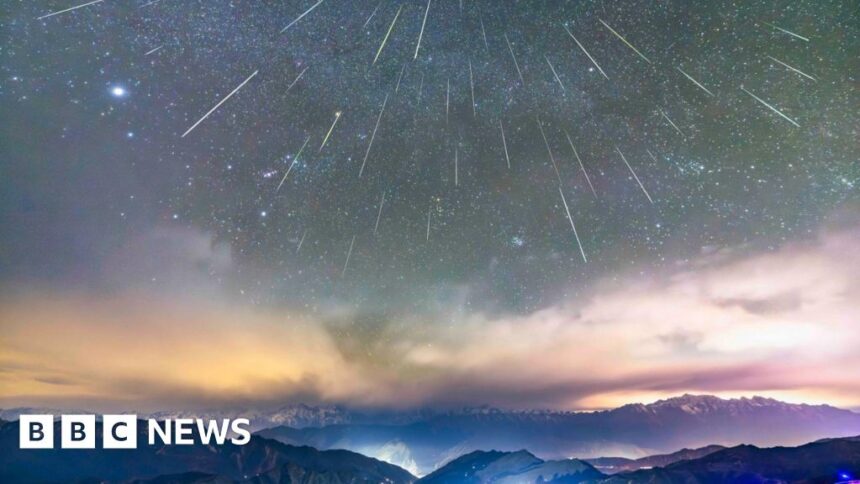
The Geminid meteor shower, renowned as one of the most breathtaking events in the celestial calendar, is set to peak this weekend. Astronomers are optimistic about the viewing conditions, provided the weather cooperates, especially for those in the Northern Hemisphere, where visibility is expected to be best.
In the UK, observers should find favorable circumstances if the skies are clear. A waning crescent Moon will not rise until after midnight, allowing several hours of dark skies ideal for viewing the meteor shower.
The Geminid meteor shower originates from the remnants of an asteroid known as 3200 Phaethon. Meteor showers occur when Earth traverses the debris trails left by comets—icy bodies often referred to as “cosmic snowballs.” In a rarer case such as the Geminids, these trails come from an asteroid. When dust and gas from these celestial bodies enter Earth’s atmosphere, they incinerate, producing the bright streaks visible to the naked eye, commonly called shooting stars. While most meteors exhibit a white glow, colors can vary based on the elemental composition, leading to displays of green, yellow, red, or blue—a phenomenon similarly observed in fireworks, thanks to metals like sodium, magnesium, and calcium.
Previously, scientists believed the Geminids were simply dust escaping from 3200 Phaethon; however, they now contend that the asteroid produces a tail composed of glowing sodium gas, introducing some uncertainty regarding the formation of the Geminid dust.
Dr. Robert Massey from the Royal Astronomical Society describes the Geminids as “pretty much the strongest meteor shower of the year.” Under optimal conditions, observers could witness up to 100 shooting stars per hour, making this event one of the year’s premier astronomical spectacles.
Despite the potential for bright moonlight to obscure some visibility, this year could offer near-ideal conditions for viewing. The crescent Moon will mostly be in shadow and absent until later in the night, especially advantageous for UK viewers looking for clear, dark skies. Local weather conditions play a crucial role, and individuals are encouraged to monitor forecasts closely for the best chances of observing the meteor shower.
For those eager to catch the Geminids, a few tips can enhance the experience. The meteors can be seen with the naked eye, so there is no need for telescopes or binoculars. Dr. Massey notes the Geminids as a cherished natural phenomenon that invites people to connect with the night sky and temporarily escape worldly concerns. While the meteors seem to radiate from the constellation Gemini, looking away from this point can yield a broader view of the celestial display.
To optimize viewing comfort, enthusiasts are advised to dress warmly, bring a blanket or reclining chair, and allow their eyes to adjust to the darkness. “You just basically need to have reasonable eyesight to see this, and I think that is incredible,” Dr. Massey remarks.
The night of peak activity is Sunday, December 14. Unfortunately, weather forecasts for the UK suggest less-than-ideal conditions, with predictions of wind and cloud cover, alongside intermittent rain. However, there may be some drier and clearer periods on Sunday night, with Northern Scotland, the Northern Isles, and certain regions in East Anglia and Southeast England likely offering the best chances to witness the shower. Observers are encouraged to keep track of local conditions, with resources such as The Met Office’s UK Cloud Cover Map providing real-time updates for optimal viewing opportunities.