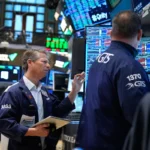
Global markets experienced notable shifts on Wednesday, driven by a combination of geopolitical tensions, economic indicators, and developments in the tech and space sectors.
Following remarks from former President Donald Trump regarding Iran, markets reacted to escalating geopolitical uncertainty. Trump claimed that the “New Regime President” of Iran had requested a ceasefire with the United States, but stipulated that Washington would only entertain the idea once the Strait of Hormuz was “open, free, and clear.” He further threatened to escalate military actions against Iran, asserting on social media, “Until then, we are blasting Iran into oblivion or, as they say, back to the Stone Ages!!!”
Iran responded swiftly, denying the existence of any ceasefire request. Iranian Foreign Minister Abbas Araghchi emphasized that there are currently no negotiations taking place, intensifying doubts about ongoing communications between the two nations. The political landscape in Iran, dominated by Supreme Leader Ayatollah Mojtaba Khamenei, adds further complexity to the situation, leaving analysts uncertain about future interactions.
In the cryptocurrency space, Bitcoin saw a bullish trend as it briefly surpassed the $69,000 mark before stabilizing around $68,000. This uptick was attributed to easing geopolitical tensions and a more favorable macroeconomic outlook. The broader crypto market also reflected this positive sentiment, with total market capitalization increasing to approximately $2.45 trillion. Despite this upward momentum, resistance levels around $69,000 to $70,000 capped further gains, as heavy selling pressure emerged in that range, indicating cautious trading behavior among investors.
Another major development that captured market attention was SpaceX’s confidential filing for an initial public offering (IPO). Reports suggested that the space exploration company is seeking a valuation exceeding $1.75 trillion, which, if realized, could yield the largest stock market listing in history, surpassing Saudi Aramco’s record from 2019. The anticipated IPO reflects growing investor optimism in the space economy, fueled by SpaceX’s advancements in reusable rocket technology and its Starlink satellite internet services. The recent merger with xAI, Elon Musk’s artificial intelligence venture, may further bolster investor confidence in what analysts refer to as the “Muskonomy”—a network of interconnected companies led by Musk.
In the labor market, new data revealed that US private sector hiring showed a slight uptick in growth, albeit unevenly distributed across various industries. According to the latest figures from ADP, private payrolls increased by 62,000 in March, surpassing expectations but still trailing behind revised figures from February. Notably, job creation was predominantly concentrated in healthcare and construction, with the former sector adding 58,000 roles and the latter contributing 30,000.
Nela Richardson, chief economist at ADP, noted that while overall hiring remains steady, growth is heavily weighted towards specific industries, particularly healthcare, which is reshaping the labor market landscape. In contrast, sectors like trade, transportation, and utilities lost 58,000 jobs, while manufacturing experienced a reduction of 11,000 positions. Interestingly, smaller firms emerged as significant contributors to job growth, adding 85,000 positions, while medium and large businesses trimmed their headcounts. Wage growth also maintained stability, with pay for workers who remained in their positions rising by 4.5% year-on-year.
As global markets react to these developments, a complex interplay of geopolitical tensions, market shifts, and evolving labor dynamics continues to shape investor sentiment and economic outlooks.