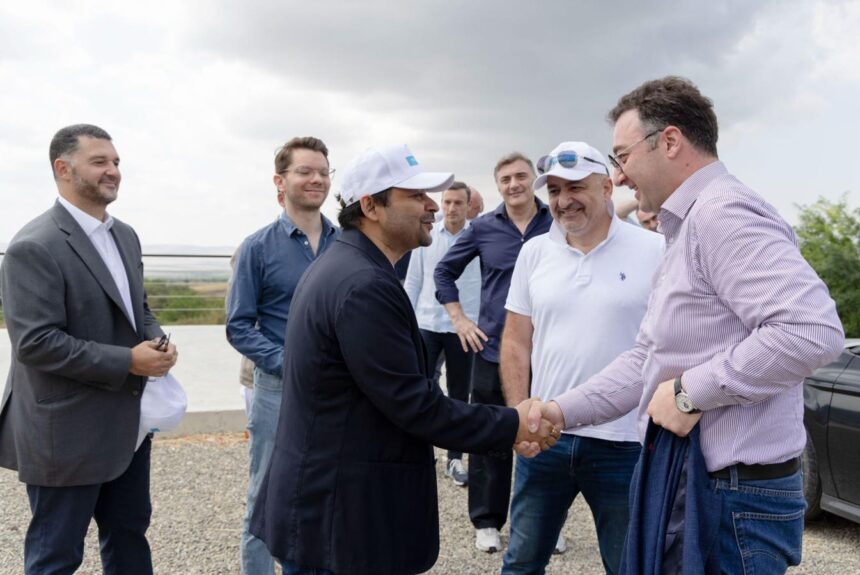
Minister of Environmental Protection and Agriculture Davit Songhulashvili recently announced a significant partnership with U.S.-based Farmway Technologies, committing to a $100 million initiative aimed at modernizing Georgia’s agricultural sector while attracting global investors through blockchain technology. This agreement marks a critical step for Georgia, positioning the nation within the burgeoning global market for real-world tokenized assets.
Farmway, led by CEO Upmanyu Misra, views this collaboration as a pioneering effort to integrate blockchain into agriculture, advocating that fractionalized investments using this technology can draw international capital for sustainable, climate-smart farming practices. “This partnership is more than an investment. It is a blueprint for how tokenized agriculture can meet the world’s climate challenges,” Misra stated. The aim is to channel international funds into Georgian farms through transparent, blockchain-enabled structures that prove the viability of real agricultural yields while bolstering local communities.
A notable aspect of this partnership is Georgia’s strategic focus on almonds, a crop with rising global demand. The current landscape in California, which produces roughly 80% of the world’s almonds, has been challenged by prolonged drought conditions, leading to fluctuations in production and subsequent price volatility. In contrast, the Kakheti region of Georgia presents a more stable irrigation environment, supported by abundant rivers. The government believes this reliability in water supply enhances investor confidence, promising a fertile ground for the almond industry.
Minister Songhulashvili emphasized the necessity of investing in modernization and technology to drive sustainable development, stating that this initiative would create job opportunities for farmers while simultaneously attracting international capital and recognition.
Farmway has previously implemented similar blockchain projects in markets such as Vietnam and Sri Lanka, where challenges like climate shocks and limited access to credit have proven detrimental to farming efficiencies. The company’s findings suggest that agriculture requires innovative financial structures to thrive, as traditional systems often render farmers undercapitalized. By fractionalizing rights to orchard yields and digitizing them into tokens, Farmway intends to create liquidity in a sector typically characterized by high barriers to investment. Such innovations are designed not only to generate income tied to productive farmland but also to instill confidence in investors by making agriculture a more accessible and transparent asset class.
Despite the potential, Farming remains a volatile industry where margins can vary significantly based on management practices. Misra noted the differences in production efficiency, using tomatoes as an example to illustrate how agricultural outputs depend on technological utilization. Encouragingly, preliminary data from the Georgian project indicates that production is exceeding expectations while costs are below projections, showcasing an efficient model of sustainability.
As the project advances, investor returns will hinge on global almond prices and operational effectiveness. Farmway is also exploring tokens linked to carbon credits, potentially introducing an additional revenue channel as verified carbon markets develop.
The Georgian government has not only expressed symbolic support for the partnership but has also established a framework that includes expedited approvals for agribusiness initiatives and a Joint Agri Taskforce to monitor progress. Minister Songhulashvili pointed to the partnership as a means to modernize agriculture in Georgia, highlighting the role of digital services and clear regulations in making the country an attractive launchpad for sustainable investment.
Future applications of tokenization could extend beyond almonds, drawing lessons from initial experiments in other countries that faced challenges such as limited farmer adoption and transparency issues. Georgia’s collaboration with Farmway aims to combine tokenization with state support and climate metrics to create a model that addresses these shortcomings effectively.
Farmway is committed to sustainable farming practices, implementing precision irrigation and regenerative methodologies to reduce costs and enhance resilience. They argue that by redefining financial mechanisms to attract capital towards climate-friendly projects, they can foster sustainability within Georgia’s agricultural sector.
Looking ahead, the success of this partnership holds high stakes for both Georgia and Farmway. For Georgia, the benefits include modernization, economic growth, and international visibility; for Farmway, it represents a critical test that could establish its leadership in real-world asset tokenization. Misra has advised that patience will be essential, as agricultural success is measured over seasons and decades rather than quarterly cycles.
Songhulashvili echoed this sentiment, emphasizing that their collaboration could showcase Georgian agriculture’s capability to deliver both economic prosperity and resilience globally. As the world recognizes food as a strategic asset class, the intersection of blockchain technology and agriculture may redefine investment paradigms, highlighting the fundamental need for sustainability in food production.