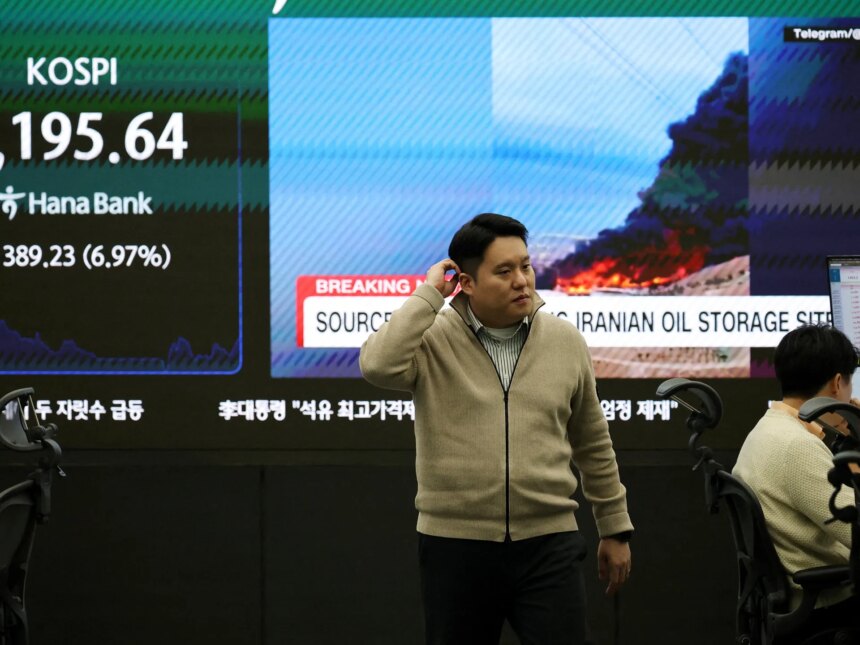
The ongoing conflict involving the United States, Israel, and Iran has created significant turmoil in global financial and energy markets, raising alarm about a potential economic downturn. The effects of these tensions have been felt across the world, revealing various distressing indicators of economic instability.
Since the escalation of hostilities on February 28, Iran has retaliated with a series of ballistic missile strikes on Israel, U.S. military installations, oil storage facilities, and other vital infrastructures throughout the Gulf region. These hostilities have led to a notable decrease in maritime traffic through the Strait of Hormuz, a critical channel for global oil and gas shipments. Notably, Iran has also targeted vessels in the strait, exacerbating the situation. As a result, crude oil prices have surged dramatically; Brent crude is now priced at $106 per barrel, a stark increase of over 40% from $72 per barrel just prior to the conflict.
Analysts project tighter energy supplies impacting the global markets. Muyu Xu, a senior analyst at Kpler, noted that liquified natural gas (LNG) prices have surged nearly 60%, with QatarEnergy suspending LNG production following drone strikes. This has put immense pressure on countries, particularly those in Asia, that rely heavily on energy imports from the Gulf. Countries are scrambling for alternative supplies amid rising costs, which is straining their economies significantly. Data reveals that a staggering 84% of crude oil and 83% of LNG passing through the Strait of Hormuz was destined for Asia, primarily China, India, Japan, and South Korea.
In light of the current scenario, economic experts have varied predictions. A report from Capital Economics suggests that if the conflict remains short-lived, we could see a sharp decline in oil prices by year-end. Conversely, if the war drags on, prices could soar to unprecedented levels, impacting global markets adversely. For example, Brent crude might rise to around $130 per barrel in the second quarter, even if shipments resume later.
The conflict is affecting economic productivity, as evidenced by a Global Petrol Prices report indicating that at least 85 countries have reported fuel price hikes since February 28. Some nations, such as Cambodia and Vietnam, have experienced remarkable increases, prompting governments to implement drastic measures to conserve fuel. Countries are adopting strategies like introducing a four-day workweek or rationing vehicle use, all of which contribute to declining productivity and an overall economic slowdown.
Financial markets are also feeling the pinch, with a 5.5% drop in global stocks since the onset of hostilities, particularly impacting Asian exchanges. Major markets such as the New York Stock Exchange and the Tokyo Stock Exchange have reported significant declines.
As inflation fears loom large, the International Monetary Fund warned of potential stagflation, a scenario characterized by rising prices coupled with stagnating economic growth. Historical crises reveal that sharp rises in oil prices frequently foreshadow recessions. Debt-laden countries in the Global South may face dire economic challenges if interest rates in the Global North rise to counteract inflation.
While regions like China have implemented energy diversification strategies to mitigate the impact, Europe is grappling with high energy costs, further exacerbating existing economic strains. The U.S., enjoying greater energy self-sufficiency, faces domestic challenges due to rising fuel prices affecting lower-income communities, notably impacting farmers already dealing with increased costs from previous trade conflicts.
Gross Domestic Product (GDP) forecasts suggest that if the war continues, the euro-zone could see growth slow to just 0.5% in the second half of the year, while China’s growth may dip below 3%. Conversely, U.S. performance remains somewhat stable, with projected growth at 2.25% by 2026.
The travel and aviation sectors are similarly disrupted. Airline ticket prices have surged as fuel costs soar, with airlines around the world citing higher operating expenses. Major carriers have struggled to restore pre-war flight frequencies due to airspace restrictions and increased fuel prices, which have jumped from about $85-$90 per barrel to $150-$200 per barrel following the conflict.
Overall, the effects of the U.S.-Israeli war on Iran are reverberating far beyond immediate regional conflicts, prompting concerns about global economic health, intensified inflation, and potential recessionary pressures, creating a complex web of challenges that governments and businesses must navigate in the coming months.