World shares experienced a notable decline on Thursday, particularly in Asia, driven by a significant sell-off in technology stocks. The retreat was further compounded by a dramatic drop in the price of bitcoin, which fell by as much as 8% during trading.
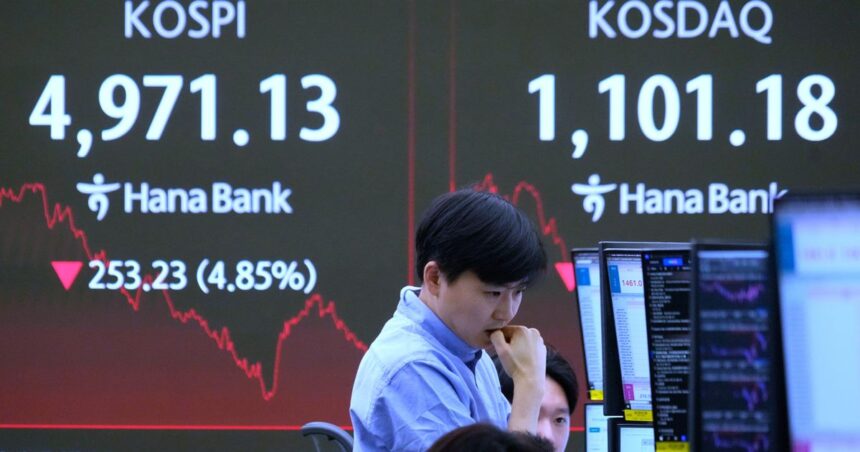
Concerns over the high valuations of tech shares led to a nearly 4% decline in South Korea’s Kospi index. Additionally, oil prices witnessed a notable decrease, falling more than $1 a barrel.
Bitcoin was trading at approximately $71,000 early Thursday but plummeted to about $69,000, marking a 7.3% decrease, which is its lowest point since November 2024. The dip in cryptocurrency values followed comments from U.S. Treasury Secretary Scott Bessent, who stated before the House Financial Services Committee that he lacked the authority to mandate banks to invest in such digital assets.
In European markets, Germany’s DAX index dipped by 0.2% to 24,568.67, while the CAC 40 in Paris saw a small gain of 0.2%, closing at 8,278.99. Conversely, Britain’s FTSE 100 experienced a 0.3% decline, settling at 10,371.83. Futures for the S&P 500 slightly increased by 0.2%, while those for the Dow Jones Industrial Average showed a marginal drop of 0.1%.
Asian trading reflected similar trends, with Tokyo’s Nikkei 225 decreasing by 0.9% to 53,818.04. The South Korean Kospi experienced a noteworthy drop of 3.9%, ending at 5,163.57. Major South Korean firms faced significant losses, with Samsung Electronics shares declining by 5.9% and chip manufacturer SK Hynix plunging by 6.7%.
Despite the overall downward trend, Hong Kong’s Hang Seng index recovered from earlier losses, finishing 0.1% higher at 26,885.24, though the Shanghai Composite index fell 0.6%, closing at 4,075.92. In Australia, the S&P/ASX 200 slipped by 0.4% to 8,889.20, and Taiwan’s Taiex lost 1.5%.
The previous day, the S&P 500 had dropped by 0.5%, marking its fifth modest loss in six days. The Dow managed a gain of 0.5%, but the Nasdaq composite fell by 1.5%. Despite more than twice as many stocks increasing within the S&P 500, the persistent decline of technology stocks dampened overall market performance.
Advanced Micro Devices saw its shares tumble by 17.3%, despite the company reporting stronger-than-expected profits for the latest quarter and providing an optimistic revenue forecast for early 2026. Investors appeared dissatisfied, largely due to the stock having doubled in value over the past year.
The pressure on tech stocks persists even as many deliver better-than-expected earnings reports. Companies, particularly in software, face uncertainty regarding competition from artificial intelligence advancements.
Uber Technologies negatively impacted market sentiment, witnessing a 5.1% drop following results that fell short of analysts’ expectations, along with a profit forecast for the current quarter that was below consensus estimates. The company also announced a new chief financial officer.
However, not all tech stocks fared poorly; Super Micro Computer surged by 13.8% after reporting an impressive profit that exceeded analyst expectations, fueled by its business in AI servers and related equipment.
In other developments, Walmart saw a modest uptick of 0.2%, marking a significant achievement as its total market value surpassed $1 trillion for the first time, placing it in an exclusive group alongside major tech giants like Nvidia and Apple.
In commodity markets, U.S. benchmark crude oil prices fell by $1.05 to $64.09 per barrel, while Brent crude lost $1.11, settling at $68.35 per barrel. Precious metals exhibited volatility, with gold bouncing up 0.2% and silver declining by 4.6%. Market analysts noted the erratic nature of precious metal prices as investors navigate uncertainties related to tariffs, a weakening U.S. dollar, and high global debt levels.
Amid shifting currency values, the dollar rose against the Japanese yen, reaching 157.03 from the previous 156.88. In contrast, the euro slipped to $1.1805 from $1.1809, highlighting ongoing fluctuations in the forex markets.