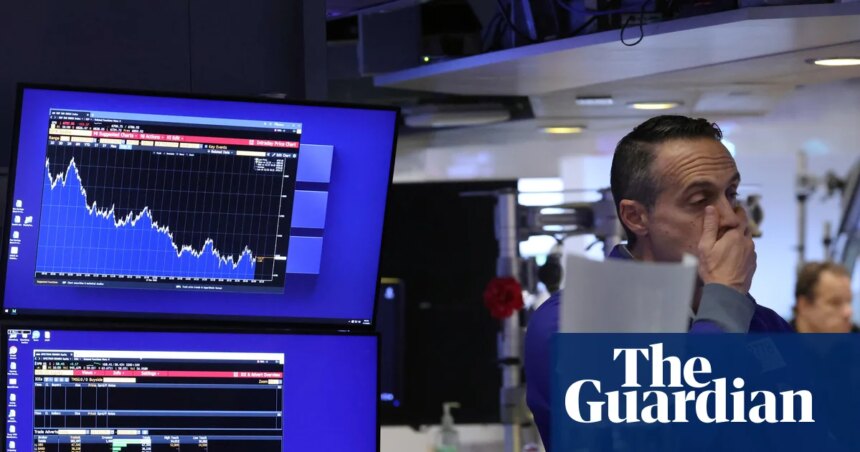
Global markets experienced a significant downturn following a tech sell-off that led to Wall Street’s bleakest performance in a month, compounded by concerning economic indicators from China that revealed an unprecedented drop in investment activity.
On Friday, Japan’s tech-heavy Nikkei saw a decline of 1.8%, while South Korea’s Kospi plunged 2.6%. Australia also reported a 1.5% drop in its markets. The tech sector, particularly companies like Nvidia, faced a sharp downturn, falling 3.6% as investors questioned the valuations of firms within the artificial intelligence landscape. This decline was exacerbated by SoftBank’s decision to divest its entire stake in Nvidia, a company valued at approximately $4.5 trillion. Other notable losses included a more than 6% drop for SoftBank and SK Hynix, followed by a 4% decrease for Samsung Electronics and a 1.8% drop for Taiwan Semiconductor Manufacturing Company.
The global markets are clearly reacting to fears surrounding a potential slowdown in the Chinese economy. Recent figures released by the National Bureau of Statistics indicated a record decline in fixed-asset investment, shrinking by 1.7% in the first ten months of the year. This prompted further dips in several Asian markets, with China’s CSI 300 declining by 0.7%, Hong Kong’s Hang Seng down by 0.9%, and Taiwan’s Taiex slumping 1.4%.
In the US, uncertainty looms over how the ongoing federal government shutdown, now the longest in history, may impact economic data releases, including inflation and employment statistics. As a result, officials are increasingly cautious about the likelihood of a Federal Reserve rate cut next month.
Jim Reid, an analyst at Deutsche Bank, noted the volatility in market sentiment this week, as relief over the shutdown’s conclusion clashed with concerns regarding AI evaluations and a more cautious tone from Federal Reserve speakers. He pointed out that the S&P 500 marked its worst day in over a month, with the probability of a rate cut in December dropping sharply from 59% to 49%.
Kyle Rodda, a senior financial market analyst at Capital.com, remarked that while Asian markets were also weak, the decline was not as severe as that seen on Wall Street. He attributed this to the more inflated valuations in the US market and identified the sell-off as stemming from a combination of altered expectations regarding Fed rate cuts and diminishing momentum in AI investments, raising concerns about their return on investment. Nevertheless, there was a brief uptick in Chinese stocks, fueled by hopes of potential stimulus from authorities in light of the unexpectedly weak investment figures.