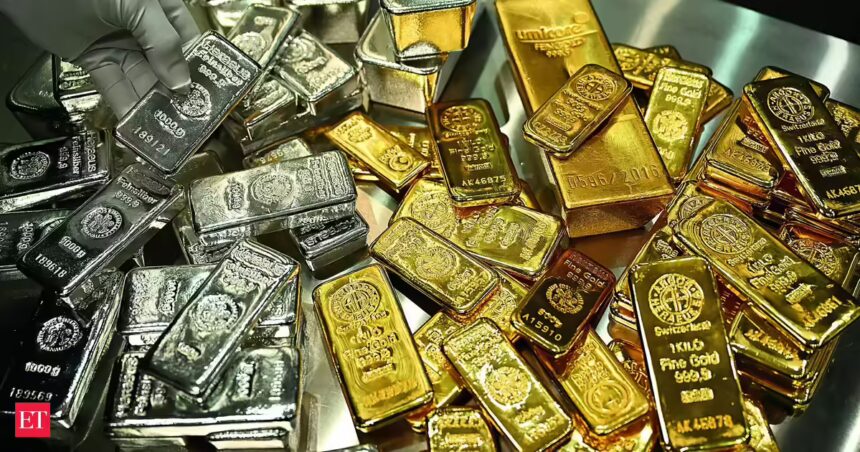
Gold and silver prices are experiencing a significant surge, primarily driven by escalating geopolitical tensions between Israel and Iran. This intensification follows Israel’s recent missile strikes on Iran, leading to substantial explosions in Tehran and raising alarms about a potential broader conflict in the region.
In the wake of these developments, investors are increasingly turning to precious metals, traditionally viewed as safe-haven assets during times of instability. Analysts suggest that this trend is expected to continue, with the possibility of further price increases if the geopolitical situation worsens.
As it stands, gold is hovering around $5,300 per ounce, while silver is closer to $93 per ounce. Market participants are keenly observing whether these metals could eventually reach $6,000 and $200, respectively. The rapid rise in prices is attributed to a confluence of factors, including declining U.S. Treasury yields, increasing inflation data, and a notable spike in gold imports from China.
Amid the current volatility, gold’s value has recently surged to a one-month high, recorded at $5,230.56 per ounce, with U.S. gold futures set at $5,247.90. This marks a significant gain of 7.6% for February alone. Silver also saw a notable increase, with spot prices up 4.8% to $92.60, reflecting an overall gain of nearly 9.7% for the month.
Experts explain that the recent geopolitical events are driving a “flight to safety” in the markets. Phillip Streible, chief market strategist at Blue Line Futures, emphasized that geopolitical risks and the potential for military operations are intensifying the demand for gold. Market forecasts suggest that gold may encounter its next significant resistance point at $5,450, with support levels situated around $5,120.
Further complicating the landscape, U.S. producer prices indicate a trend towards inflation, which enhances the allure of gold and silver as protective investments. Simultaneously, the yield on U.S. 10-year Treasury bonds has dipped to a three-month low, thereby minimizing the opportunity costs associated with holding gold.
On the global front, China’s gold imports via Hong Kong saw a remarkable increase of 68.7% in January from December, contributing to the burgeoning demand for gold. This uptick is partly influenced by recent adjustments in Chinese forex regulations, encouraging purchases of dollar-denominated assets and thus impacting global metals pricing.
Looking ahead, analysts believe that if geopolitical tensions persist, the likelihood of gold and silver reaching higher price points strengthens. Gold’s potential trajectory could reach $6,000, contingent upon sustained demand and ongoing global uncertainty, while silver might target the $200 mark under similar circumstances.
Market observers are closely monitoring ongoing developments, including potential U.S.-Iran nuclear talks, military actions, and economic indicators relevant to Chinese import data. Such events could play a crucial role in shaping the future of gold and silver prices.
For investors strategizing in this turbulent environment, it is paramount to stay informed on geopolitical trends and market signals. Diversification and careful observation of key economic metrics, such as inflation data and Treasury yields, are recommended to effectively manage risk while capitalizing on the potential for gains in precious metals.