Good morning, and thank you for joining our ongoing coverage of business and financial developments.
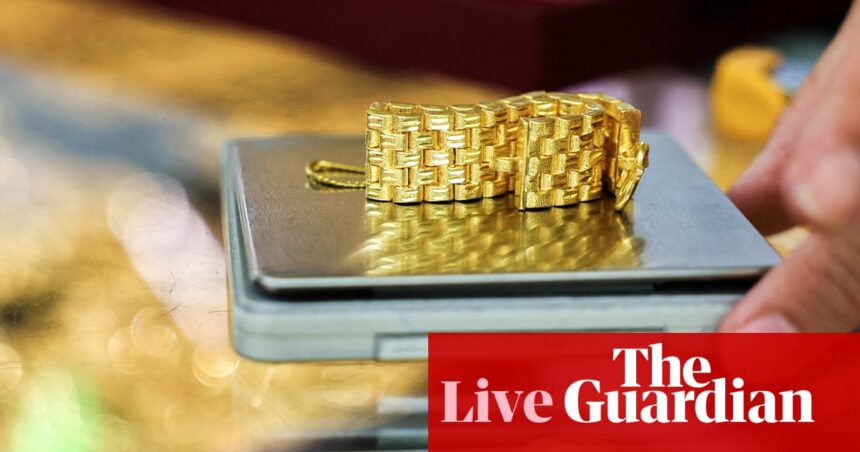
Gold prices have surged to a new record high of $3,759 per ounce, reflecting a significant 9% increase just this month and an impressive 43% rise since the beginning of the year. The ascent of gold is attributed to various geopolitical tensions, expectations of interest rate cuts, and pervasive concerns that financial markets may have reached unsustainable levels.
Analysts emphasize gold’s traditional role as a safe-haven asset amid global uncertainty. Ipek Ozkardeskaya, a senior analyst at Swissquote Bank, pointed to heightened geopolitical risks, particularly in Ukraine and Gaza, as key drivers of gold’s rally. In Gaza, the acknowledgment of the state of Palestine by several developed nations has strained diplomatic relations with both Israel and the United States, exemplified recently by France’s recognition. Meanwhile, fears of Russia testing NATO’s resolve through repeated airspace violations have left many countries bordering Russia apprehensive.
Concerns surrounding former President Donald Trump’s potential impact on the U.S. fiscal landscape are also fostering interest in gold. His inclination to increase borrowing and undermine the Federal Reserve’s credibility adds to the allure of gold as a substantial investment opportunity.
This surge in gold demand is not only seen among individual investors but also from central banks, which are ramping up gold purchases this year in an attempt to decrease their reliance on the U.S. dollar. Typically, gold does not yield returns in the form of interest or dividends, rendering it less attractive compared to cash deposits or bonds. However, decreasing interest rates could mitigate this disadvantage.
In other news today, Trump is scheduled to meet with Argentina’s president regarding possible financial support for Javier Milei’s government, which is currently grappling with a currency crisis. Investors are also looking forward to remarks from Federal Reserve Chair Jerome Powell later today to gain insight into potential future rate cuts.
Today’s economic agenda includes the following key events:
– 8:30 AM BST: Sweden interest rate decision
– 9:00 AM BST: Eurozone flash PMI for September
– 9:30 AM BST: UK flash PMI for September
– 10:00 AM BST: Bank of England chief economist Huw Pill speaking at the Pictet Research Institute Symposium
– 11:00 AM BST: CBI industrial trends report
– 5:35 PM BST: Federal Reserve Chair Jerome Powell speaks in New York
In the automotive sector, Jaguar Land Rover (JLR) has announced an extension of its production freeze, continuing its halt in manufacturing for an additional week following a cyber-attack. Business Secretary Peter Kyle is visiting JLR today to discuss support for the supply chain affected by the stoppage. JLR’s shutdown has resulted in missed production of approximately 1,000 vehicles per day, costing the company an estimated £72 million daily in lost sales.
The company clarified that the decision to extend the production pause is aimed at providing clarity as it works towards a phased operational restart while coordinating with cybersecurity experts and law enforcement.
Meanwhile, the surge in gold prices puts it on track for its best year since 1979, a period marked by severe inflation and economic turbulence. Market strategist Jim Reid noted that compared to historical gains, gold has returned a remarkable 1,280% since 2000, outperforming other asset classes like the S&P and Nasdaq.
Closing on a somber note, Caledonia Mining Corporation reported a tragic accident at its Blanket Mine in Zimbabwe, resulting in the death of one employee. The company has expressed its condolences and is prioritizing the safety and well-being of all personnel involved as it conducts a full investigation.
As the landscape continues to evolve, gold remains a focal point for investors seeking stability in uncertain times, underlining the persistence of doubt that keeps its value in demand.