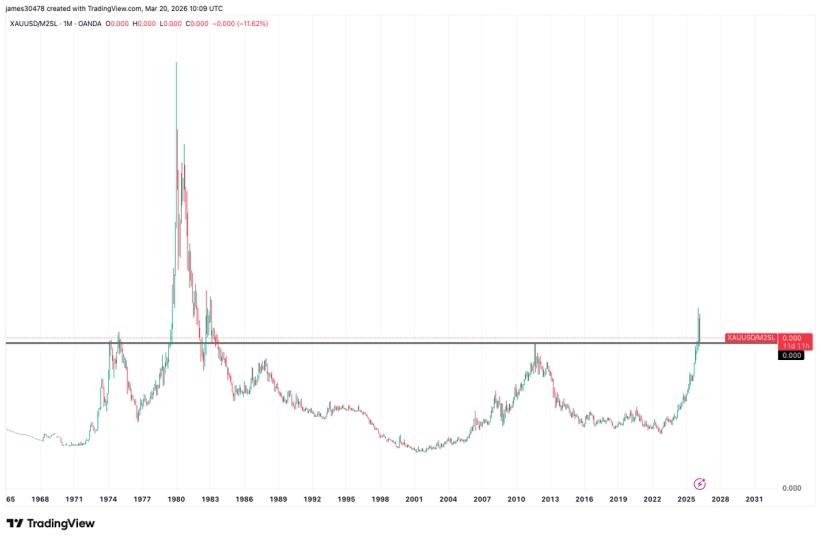
Gold has recently come under significant pressure in the markets, nearing a technical bear market status after declining nearly 20% from its all-time high reached in January. Once regarded as a safe haven and a reliable hedge against geopolitical instability, the yellow metal’s recent performance is calling this perception into question. In the wake of escalating tensions in the Middle East, gold prices have dropped approximately 10% since the conflict intensified at the end of February, defying expectations that such turmoil would drive prices higher.
The landscape has shifted dramatically as markets have recalibrated their outlook on interest rates. With predictions now favoring a restrictive policy environment anticipated to last at least through December 2026, gold finds itself battling against this backdrop. Coupled with rising oil prices—prompted by geopolitical risk—there is growing pressure on inflation, which further entrenches the belief in a “higher for longer” interest rate environment. This situation poses a significant challenge for gold, which typically thrives in lower-rate conditions.
Notably, when adjusting for the M2 money supply, which includes cash, deposits, and other readily available forms of money, gold is trading near levels reminiscent of critical historical peaks. In 1974, gold hovered around $200 per ounce, and by 2011, it had reached about $1,800 per ounce. In this context, the current gold pricing seems to be stabilizing at relatively high levels, potentially indicating the formation of a cyclical floor relative to global liquidity.
In contrast to gold, Bitcoin is currently in a similar consolidation phase when adjusting for the M2 money supply, mirroring trends observed in 2024. This cryptocurrency is also retesting its 2021 highs in liquidity-adjusted terms. Historically, Bitcoin has shown a tendency to exceed previous peaks when benchmarked against money supply metrics. As Bitcoin remains approximately 40% below its high from October, some analysts suggest that this may represent a normal consolidation range preceding potential upward movement.
Interestingly, recent trading data indicates that gold and Bitcoin have displayed a positive correlation, moving in sync with each other for the first time since a decline from Bitcoin’s previous high of $5,000 on Wednesday. This shift suggests that market dynamics may be changing, as both assets respond to broader economic indicators in a more interconnected manner than seen previously.