In 2025, a significant shift occurred in the financial landscape, with gold decisively outpacing Bitcoin in what many refer to as the “sound money” or debasement trade. Gold experienced a remarkable surge, marking one of its best performance years with a staggering 65% increase. In stark contrast, Bitcoin faced a downturn, declining by 7%.
Up until August, the two assets had displayed relatively similar trajectories, both enjoying an upswing of approximately 30%. However, from that point onward, gold saw a meteoric rise while Bitcoin experienced a sharp decline, crystallizing the narrative that gold had triumphed in the fight for monetary resilience while Bitcoin lagged behind.
Currently, Bitcoin is navigating a recovery phase after enduring a 36% correction from its all-time high reached in October. The asset now hovers around the $80,000 mark and faces challenges in regaining its previous momentum. Interestingly, despite the decline in Bitcoin’s price, capital flows into the asset tell a contrasting story. Bradley Duke, managing director at Bitwise, noted that the inflows into Bitcoin exchange-traded products (ETPs) exceeded those of gold ETPs during the year, highlighting a continued interest in the cryptocurrency despite gold’s exceptional performance.
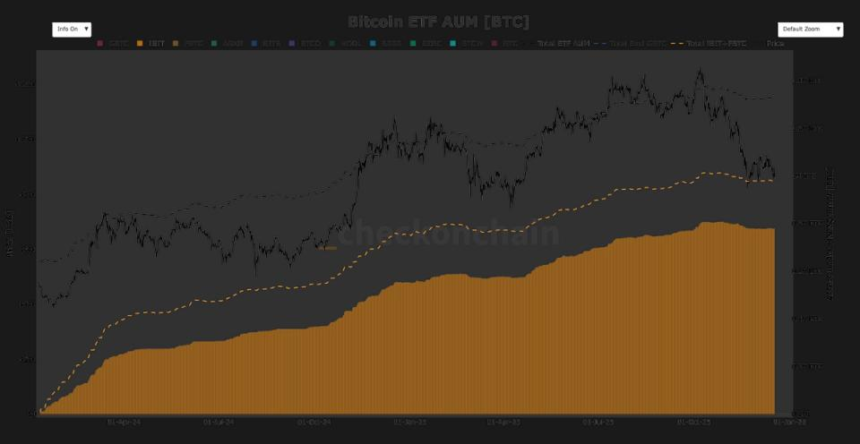
The introduction of U.S. spot Bitcoin ETFs in January 2024 set the stage for a new era of institutional engagement, with 2025 solidifying this trend through sustained participation, even amid Bitcoin’s price struggles. A key observation from the current correction period is the resilience shown by ETF investors. Although Bitcoin’s value dropped by 36%, total assets under management (AUM) for Bitcoin ETFs decreased by less than 4%. According to data from Checkonchain, U.S. ETFs initially held 1.37 million BTC at the peak in October and still maintained around 1.32 million by mid-December, suggesting that most of the sell-off did not originate from ETF holders.
Moreover, BlackRock’s iShares Bitcoin Trust (IBIT) has solidified its position during this correction, now accounting for nearly 60% of the market share with about 780,000 BTC under management. This shift further emphasizes that the driving force behind Bitcoin’s recent price decline was not attributed to ETF outflows.
In conclusion, the developments throughout 2025 highlight a clear preference for gold among investors seeking a secure store of value, while Bitcoin, despite its challenges, continues to draw interest in the institutional space, signaling potential for future recovery.