









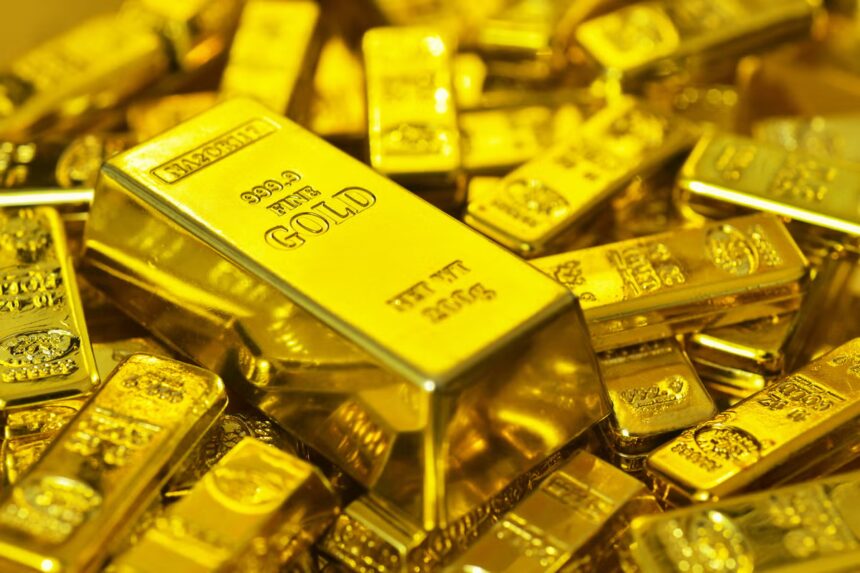
The price of gold has reached unprecedented heights, surpassing $4,000 per ounce for the first time, driven by various factors including geopolitical unrest and economic volatility linked to the policies of the U.S. government under President Donald Trump. This surge represents a significant increase of over 50% this year alone, jumping from approximately $2,670 per ounce at the beginning of January.
Gold has long been viewed as a safe haven asset during turbulent times, and the current trajectory suggests that it may soon achieve prices not seen since 1979, when inflation and currency depreciation caused gold’s value to double. The depreciation of the U.S. dollar has become a crucial element in this shift towards gold investment. With expected cuts to interest rates from the Federal Reserve and ongoing concerns regarding national debt levels, the dollar’s stability is under scrutiny. The recent downgrade by Moody’s, which stripped the U.S. of its top credit rating, further exacerbates this concern.
Ken Griffin, founder of Citadel, expressed his apprehension regarding gold’s price surge, indicating that it could signify a broader trend of asset inflation away from the dollar. The dollar has already experienced a 10% decrease in value over the course of this year, and an inflation rate standing at 2.9% has diminished its purchasing power well below the Federal Reserve’s target of 2%.
Instability within the U.S., catalyzed by civil unrest linked to Trump’s controversial approaches—including threats of military intervention in U.S. cities and the looming threat of a government shutdown—has contributed to a growing distrust in American institutions. Peter Grant, vice president and senior metals strategist at Zaner Metals, noted that the ongoing government shutdown is contributing to investors’ moves toward gold.
Retail investors, too, have increasingly turned to gold as a safeguard against inflation, influenced by the implementation of heavy tariffs by the Trump administration that affect global trade. The situation isn’t isolated to American turmoil; international economic developments have also stirred market reactions. For instance, the Japanese yen has fallen to a seven-month low following the election of a new prime minister, Sanae Takaichi, who has pledged aggressive economic stimulus.
The European market faced its own upheaval with the abrupt resignation of French Prime Minister Sébastien Lecornu, which marked one of the shortest terms in French political history. This resignation caused further instability, prompting investors to favor gold as a more reliable investment amid the fragility of the euro.
Responding to these dynamic circumstances, Goldman Sachs has elevated its projected gold price for 2026, increasing it to $4,900 per ounce from a prior forecast of $4,300, indicating a robust influx of ETF investments and anticipated ongoing purchases by central banks.
The current landscape underscores a clear trend: global uncertainty is prompting investors to gravitate towards gold, reinforcing its status as a refuge amid economic and political turbulence.