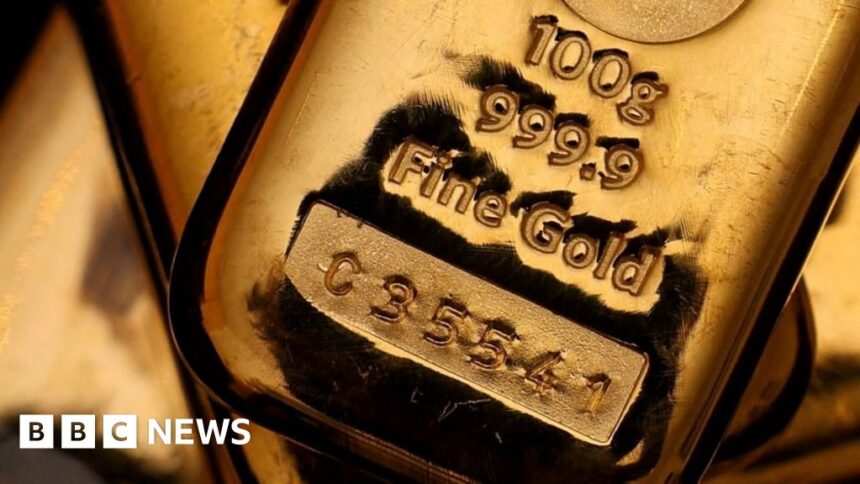
The price of gold has surged past $5,000 per ounce for the first time, marking an extraordinary milestone in a growing trend that saw the metal’s value increase by more than 60% in 2025. This surge is occurring against a backdrop of escalating geopolitical tensions, particularly between the United States and NATO regarding Greenland, which has further fueled concerns about financial instability.
The situation has been exacerbated by U.S. President Donald Trump’s recent trade threats. In a bold move, he indicated the possibility of imposing a 100% tariff on Canada should it finalize a trade agreement with China, casting a shadow over global markets. In times of uncertainty, investors often flock to gold and other precious metals, viewing them as safe-haven assets. This trend is evident as silver also reached a historic price of over $100 per ounce, following its impressive 150% rise the previous year.
Several interconnected factors have driven the demand for precious metals. High inflation rates, a weakening U.S. dollar, and aggressive buying from central banks around the world have all played significant roles. Furthermore, the expectation that the U.S. Federal Reserve will cut interest rates later in the year has added to the appeal of these assets. The ongoing wars in Ukraine and Gaza, along with geopolitical maneuvers involving the U.S., such as the seizure of Venezuelan President Nicolás Maduro’s assets, have contributed to the rising gold prices.
Gold’s allure is partly due to its limited supply. According to the World Gold Council, roughly 216,265 metric tonnes of gold have been mined throughout history—enough to fill three to four Olympic-sized swimming pools, with most of it extracted since 1950 thanks to advancements in mining technology. The U.S. Geological Survey estimates there are still about 64,000 tonnes available in underground reserves, but production is expected to plateau soon.
Investors see gold as a prudent diversification strategy, especially in uncertain times. Nicholas Frappell, global head of institutional markets at ABC Refinery, noted that gold ownership is independent of external debts linked to bonds or equities, making it an appealing choice for risk-averse investors. “It’s a really good diversifier in a very uncertain world,” he stated.
The monumental growth of gold’s value in 2025, the most significant annual increase since 1979, has been fueled by growing global fears, particularly those related to U.S. policy and the volatility of other investment options, including artificially inflated tech stocks. Nikos Kavlis from Metals Focus remarked that “a large part of that is the extreme uncertainty we have around U.S. policy.”
Gold typically benefits from declining interest rates, as lower returns on bonds prompt investors to seek alternatives like gold and silver. With the Federal Reserve anticipated to cut its main interest rate twice in the coming months, the future of gold continues to look bright, although analysts like Ahmad Assiri, Research Strategist at Pepperstone, caution that this “news-driven” market could also cause unexpected downturns in gold prices.
Demand isn’t limited to investment; cultural practices also play a role. In many regions, gold is purchased during festivals or given as gifts, especially during significant occasions like weddings. In India, the Diwali festival is a particularly auspicious time for acquiring gold, with Indian households amassing an impressive $3.8 trillion in gold, equivalent to nearly 89% of the nation’s GDP. Meanwhile, China remains the world’s largest consumer market for gold, with many viewing it as a harbinger of fortune, particularly as the Chinese New Year approaches.
As gold continues its ascent, analysts stress the importance of monitoring the broader economic and geopolitical landscapes that could impact its trajectory in the months ahead.