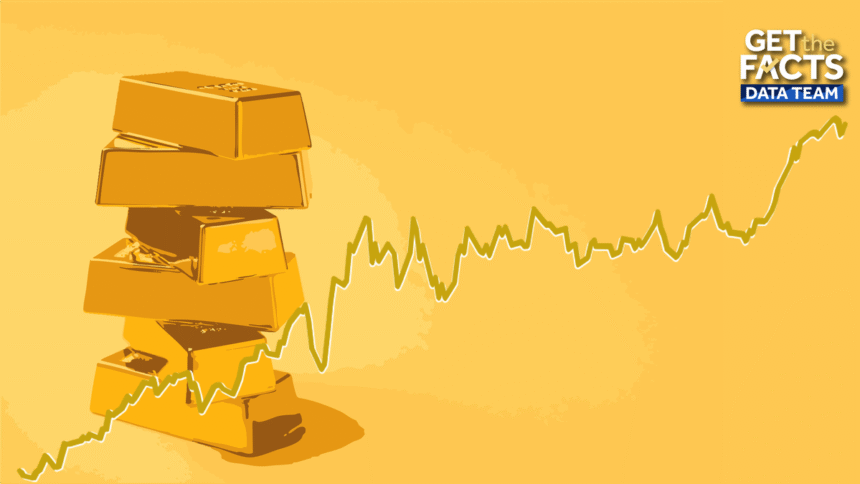
Gold prices have soared to historic highs, now approaching the $4,000 mark after a staggering 45% increase this year, climbing from $2,669 in January. This surge has garnered significant attention as investors have increasingly turned to gold as a safe-haven asset amid economic uncertainties, particularly in light of the looming U.S. government shutdown. Historically, during previous shutdowns, gold prices have risen, reinforcing its status as a reliable store of value.
Once regarded as the “currency of kings,” gold has transformed in modern markets, shifting from a primary trade item to a protective asset against market volatility. Its unique properties—durability, malleability, and resistance to tarnish—have contributed to its enduring value. Unlike stocks or bonds, gold can be physically stored and exchanged, which adds to its appeal during tumultuous times.
Andrea Bubula, a senior lecturer at Columbia University specializing in economic analysis for international affairs, notes that the 2009 Venezuelan banking crisis highlighted vulnerabilities in financial systems. During that crisis, then-President Hugo Chavez seized control of several private banks, prompting central banks worldwide to reconsider their asset allocations. “Gold is good because it is typically negatively correlated with markets, so when markets do badly, gold does well,” Bubula explained.
Supporting this narrative, the World Gold Council has reported that central banks have significantly increased their gold reserves, doubling from an average of 400-500 tons over the past decade to 1,000 tons in the last three years. Taylor Burnette, the research lead for the Americas at the World Gold Council, identified three primary drivers of gold demand: jewelry and technology, investors, and central banks. Notably, this year, the most substantial demand has come from investors, including family offices and high-net-worth individuals eager to diversify their portfolios. Burnette indicated that typical gold allocations in investment portfolios range from 2% to 10%, with an average of about 5%.
The recent rally in gold prices has also benefited from external factors. A weaker U.S. dollar has made gold more attractive, as the dollar index has dropped over 10% since January. “When the dollar weakens, the price of gold increases,” Bubula clarified, noting the direct correlation between the two. Additionally, he pointed out that gold’s value has risen across other currencies, including euros and yen, suggesting that global demand remains robust regardless of exchange rate fluctuations.
The World Gold Council’s second-quarter report highlighted that total quarterly gold demand rose to 1,249 metric tons (over 40 million troy ounces), marking a 3% increase year-on-year. Significant drivers included investments through gold ETFs, which accounted for 170 metric tons. This surge in demand appears to be a response to an increasingly unpredictable geopolitical landscape and price momentum, as investors seek stability by opting for gold over more volatile assets.
Nonetheless, investing in gold is not without its drawbacks. Costs associated with storage and insurance arise, as physical gold can be susceptible to theft. Moreover, unlike stocks that yield dividends or bonds that pay interest, gold does not generate income, presenting a unique challenge for investors. Bubula noted that while gold serves as a safeguard against market losses, it lacks some benefits provided by traditional financial assets.