



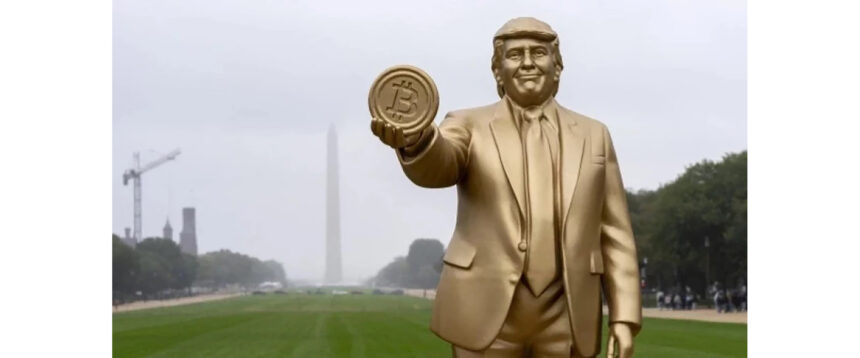
In a striking evolution of political symbolism, the recent installation of a 12-foot-tall golden statue of Donald Trump holding a Bitcoin outside the U.S. Capitol starkly contrasts the chaotic events of January 6, 2021, when supporters erected a gallows on the same grounds. Officially, this statue is attributed to a group of cryptocurrency investors who aim to spark dialogue about America’s financial trajectory, particularly in light of the Federal Reserve’s latest interest rate cuts.
Hichem Zaghdoudi, representing the creators, described the statue as a “symbol of the intersection between modern politics and financial innovation.” He expressed hope that the statue would spark reflections on cryptocurrency’s expanding role in the economy. The statue’s unveiling has prompted speculation about Trump’s involvement, given his well-documented affinity for gold. However, like the gallows from two years ago, Trump remains free from direct accountability for this artistic gesture.
The fascination with gold has emerged as a recurring theme among Trump supporters. Christian nationalist Pastor Shane Vaughn has noted the perceived “upgrades” Trump has brought to the Oval Office, claiming it now resembles Buckingham Palace. Vaughn emphasized America’s greatness, proclaiming, “Gold is godly,” and asserting that the U.S. was founded under divine decree, where opulence is seen as reflective of heavenly ideals.
The golden statue is not the first of its kind to make headlines. Earlier this year, an AI-generated video depicted surreal scenes featuring more golden Trump figures and paraphernalia, indicating a growing trend of exaggerated idolization within conservative circles. Reference to the 2021 Conservative Political Action Conference (CPAC) further illustrates this phenomenon; a prior golden Trump statue at the event sparked notable discussions about the Republican Party’s current embrace of Trump as a near-mythical figure.
Critics have drawn uncomfortable parallels between these statues and the biblical idol worship seen in Exodus, yet the statue’s creator, Tommy Zegan, defended it against claims of idolatry, insisting it remains merely a sculpture.
This golden statue phenomenon is emblematic of a broader transformation in political discourse, increasingly driven by memes and visual representations rather than substantive debate. Matthew D. Taylor notes that the independent leadership culture within conservative movements resembles a marketplace of ideas, where visuals and memes dominate the conversation, often divorced from traditional theological underpinnings.
These types of symbols have gained popularity on the far right, particularly in notable instances such as the “Appeal to Heaven” flag, which intertwines a Revolutionary War slogan with contemporary right-wing sentiments. This evolving meme culture raises questions about the motivations driving such idolization. For many, aligning with Trump provides a sense of power and identity, making gold—a material often associated with wealth and divinity—an appealing metaphor.
In a twist of irony, conversations around golden Trump statues highlight the alarming ease with which right-wing factions adopt imagery and ideologies that mirror what they claim to oppose. Critiques of the purported authoritarianism of the left become code for their own practices, leading to unsettling reflections on the nature of allegiance and idolization in today’s political landscape.
As the narrative continues to unfold, these golden statues serve not only as artifacts of political expression but also as lenses through which we can examine the complex interplay of faith, politics, and cultural symbolism in modern America.