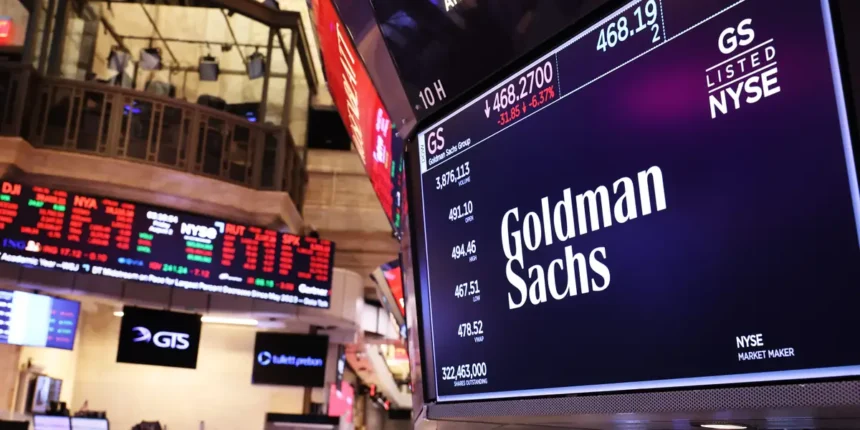
Goldman Sachs has issued a stark warning to investors about the potential for further downturns in the stock market, highlighting a growing sense of urgency as safe haven options dwindle. In a recent note directed at clients, the investment bank’s strategists expressed concerns over the possibility of an impending stock correction, which is characterized by a market decline of 10% or more. Currently, the S&P 500 has already slipped 5% from its peak earlier this year, suggesting that another 5% drop would push the index into correction territory.
Goldman Sachs outlined a variety of adverse scenarios based on its comprehensive cross-asset analysis and the Risk Appetite Indicator, a tool that gauges investor sentiment. In one of these scenarios, the strategists anticipate that equities could fall an additional 7% to 8% from their present levels. The bank cautioned that bonds, typically viewed as a protective investment during market downturns, are unlikely to provide adequate safety in a significant market decline.
Several persistent headwinds have been identified that could exacerbate the challenges facing the equity market. Factors such as disruption from artificial intelligence, ongoing geopolitical tensions, and escalating fears regarding inflation have created a precarious environment for investors. A particularly troubling development has been the recent spike in oil prices, which threatens to drive inflation higher while simultaneously hindering economic growth—a dual blow to equities.
Moreover, the bond market is also feeling the pressure from rising inflation. The yield on the 10-year US Treasury note has climbed to 4.31%, an increase of 35 basis points since the outset of the conflict in Iran. This rise signals heightened inflation expectations, and Goldman noticed that the correlation between stocks and bonds has shifted to positive, which has further strained multi-asset portfolios.
The current landscape for safe-haven investments has also seen a downturn, with gold prices dropping 14% from their peak in late January. This trend reflects not only speculative pressures but also shifting investor expectations related to interest rates.
In response to these challenging market conditions, Goldman Sachs has advised investors to consider increasing their allocations toward defensive, high-quality stocks and to be selective in their investments in safe assets. This strategy aims to mitigate risks associated with potential stagflation, a situation characterized by stagnant economic growth coupled with rising inflation.