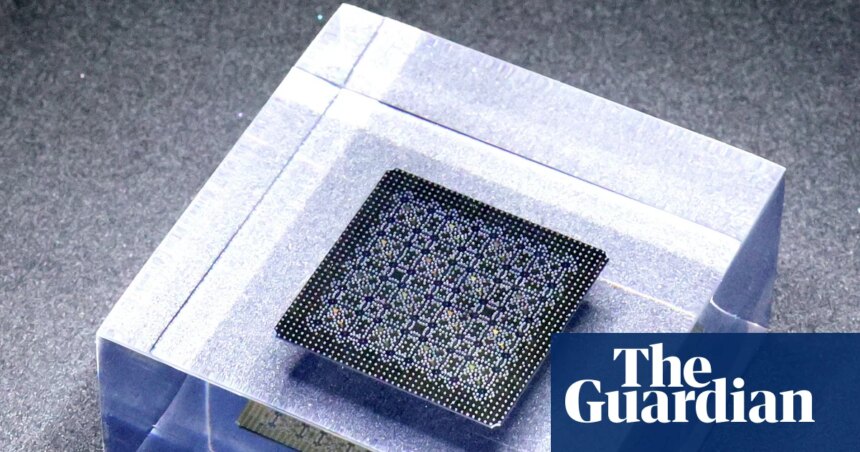
In a significant advancement for quantum computing, Google has announced the development of an innovative algorithm that accomplishes tasks surpassing the capabilities of conventional computers. This groundbreaking algorithm has enabled a quantum computer to successfully compute the structure of a molecule, potentially opening new frontiers in fields like medicine and materials science. While Google emphasized the promise of this breakthrough, it acknowledged that practical implementation of quantum computers remains several years away.
“This is the first time in history that any quantum computer has successfully run a verifiable algorithm that exceeds the power of supercomputers,” Google stated in a recent blog post. They described this accomplishment as a step toward scalable verification, edging quantum computers closer to practical applications.
Michel Devoret, the chief scientist of Google’s quantum AI unit and a recent Nobel laureate in physics, underscored the milestone, indicating that it represents significant progress in the journey toward full-scale quantum computation. The details of the algorithm, indicating that it operates 13,000 times faster than classical systems, were published in a peer-reviewed paper in the journal Nature.
While the achievement has garnered widespread attention, some experts have expressed caution. Winfried Hensinger, a professor at the University of Sussex specializing in quantum technologies, noted that although Google has proven “quantum advantage,” the application remains limited to a specific scientific problem without immediate real-world implications. The findings were validated using nuclear magnetic resonance (NMR), the technology behind MRI scans, revealing insights not typically obtained through traditional methods.
Despite this progress, the aspiration to develop fully fault-tolerant quantum systems remains a challenge, as these would necessitate machines capable of supporting hundreds of thousands of qubits. Current quantum hardware falls short, as qubits are notoriously unstable and require stringent environmental controls.
“It’s important to realize that the feat accomplished by Google is not as revolutionary as the transformative applications anticipated for quantum technology,” Hensinger remarked. He added that true quantum computers capable of tackling a wider array of challenges would need millions or even billions of qubits, a demand that current hardware cannot meet due to the complexities involved.
Hartmut Neven, a vice-president of engineering at Google, expressed optimism about the potential of real-world applications arising from their advancements, suggesting that such milestones might emerge within five years. The company also posited that quantum computers could generate unique data sets that enhance artificial intelligence models, further integrating these two fields.
In contrast to classical computers that utilize bits—represented as binary digits (0 or 1)—quantum computers leverage qubits, which can exist in multiple states simultaneously due to the principles of quantum physics, such as superposition. This characteristic allows qubits to process vast combinations of data concurrently, a feat unattainable by classical systems. However, the delicate nature of qubits necessitates highly controlled conditions to avoid disruptions.
Meanwhile, the rapid advancements in quantum technology have raised alarms among cybersecurity experts, who caution that such innovations could undermine current encryption methods. This has led to calls for the adoption of quantum-proof cryptography to safeguard sensitive information in the face of evolving threats.