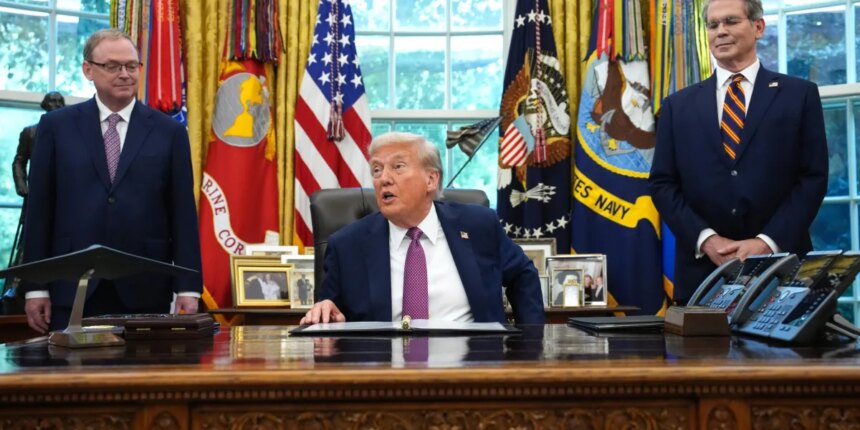
In a recent discussion, Kevin Hassett, director of the National Economic Council and a frontrunner for the Federal Reserve chairmanship, emphasized the positive impact of President Donald Trump’s tariffs on addressing America’s substantial national debt, which currently stands at $38 trillion. Speaking with billionaire David Rubenstein, Hassett maintained that the tariffs are not only a critical component of the administration’s economic strategy but also contribute significantly to increasing revenue for the Treasury.
Hassett highlighted that the first step in managing the national debt is to reduce it relative to economic targets, a goal he claims is being met through recent reductions in the federal deficit. He expressed optimism about the American economy’s growth and pointed out that the tariff revenues, paired with what he described as greater spending restraint compared to previous years, are key elements in this financial strategy.
While emphasizing the importance of tariffs in fostering a supply-side economic approach, Hassett asserted that they could potentially enhance economic growth, broaden the tax base, and alleviate the debt burden in the long run. His statements come amid contrasting views within the administration regarding the effectiveness and sustainability of tariff revenue. Treasury Secretary Scott Bessent, speaking at the DealBook Summit, characterized tariff revenues as a “shrinking ice cube,” hinting at their temporary nature. This stance was corroborated by a recent Congressional Budget Office (CBO) report indicating that the savings on the national debt have decreased by $1 trillion over a few months, largely due to diminishing effective tariff rates resulting from ongoing trade negotiations.
Adding to the discourse, economic analysts noted that although the anticipated increase in tariff revenue from 2024 to 2025 could be significant, current trends indicate that collections have fallen far short of initial projections. Notably, Pantheon Macroeconomics reported that tariffs have yielded approximately $100 billion less than the Trump administration had predicted, largely due to a sharp decline in imports from China.
Critics of Hassett’s optimism regarding spending restraint include watchdog organizations like the Peter G. Peterson Institute and the Committee for a Responsible Federal Budget, both of which have pointed out the rapid increase in national debt growth, reportedly by $1 trillion in just two months—the fastest recorded outside of pandemic-related circumstances.
In defense of the tariff policies, Bessent reiterated their positive role in generating critical revenue and supporting domestic labor markets. He asserted that the ultimate objective is not to use tariffs as a permanent revenue stream, but rather to restore balance to trade and revitalize American manufacturing.
As discussions regarding tariffs continue, the Supreme Court is currently deliberating whether Trump overstepped his authority by employing the 1977 International Emergency Economic Powers Act to institute tariffs that exceeded the typical scope of past administrations. Bessent expressed concerns that if the Supreme Court were to invalidate many of the tariffs, it would represent a significant setback for both the administration and American workers. Hassett, for his part, argued that the invocation of emergency powers is justified due to the long-term social ramifications associated with extensive trade deficits, which he links to detrimental effects on American communities, including rising addiction rates. He remains confident that the Supreme Court will ultimately uphold the administration’s tariffs, reiterating that they should be viewed as temporary price shocks rather than a consistent inflationary factor.