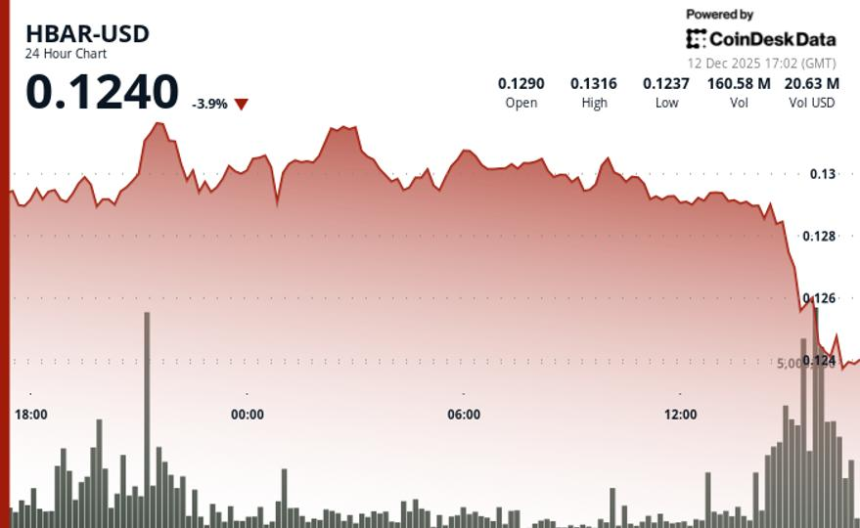
HBAR experienced a downturn on Thursday, declining by 4% to $0.1247 after breaching several technical levels during an afternoon selloff. The native token of the Hedera network exhibited a volatility range of $0.0082, marking a 6.4% fluctuation, as resistance at $0.1320 continued to thwart bulls’ attempts to extend gains.
Volume patterns indicated an increase in institutional participation throughout the trading session, suggesting that the surge in activity was reflective of genuine price discovery rather than the low-liquidity movements typically associated with smaller altcoins. The sharp decline established a clear pattern of lower highs from the spike seen on December 11, leading to a deteriorating market structure that accelerated downward momentum through previously established support zones.
The critical support level at $0.1235 became pivotal as HBAR tested this threshold, following rejection at the strong $0.1320 resistance. A stabilization pattern forming around the $0.124-$0.125 range after the dramatic capitulation hints at potential mean reversion back to the resistance level at $0.126. However, traders are exercising caution due to the definitive break of higher timeframe support levels and the notable volume during the decline, which signals conviction selling. This indicates limited near-term upside potential, even as prices temporarily recover to provide some relief to bulls.
In terms of technical analysis, immediate support is now entrenched at $0.1235 after the afternoon drop, while resistance remains robust at $0.1320 following multiple failed attempts to breach this level. The new trading range is set between $0.123-$0.125 on 60-minute timeframes.
Volume analysis reflects a significant surge to 165.9 million tokens traded, which is 175% above the 24-hour average, indicating heightened interest during this key reversal. Specifically, the flash crash volume peaked at 15.7 million tokens, a staggering 700% increase over the hourly average, underscoring sustained above-average activity confirming institutional involvement.
Chart patterns suggest that a lower highs trend has been established since the December 11 peak, which contributes to a bearish market structure. The recent flash crash followed by a recovery indicates an accumulation phase near the established support.
Looking ahead, the immediate upside target is set at $0.126 for potential mean reversion, whereas downside risk could press towards the $0.123 support floor should the current consolidation fail. Key resistance still looms at $0.1285, marking the initial breakdown point.