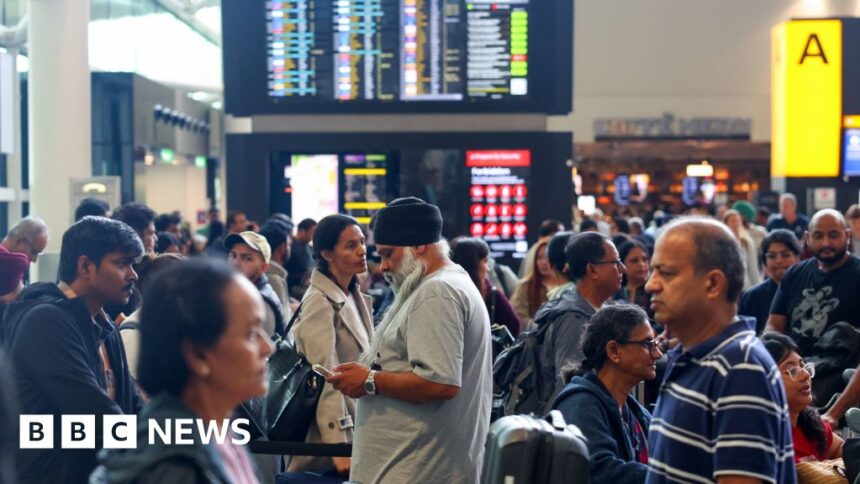
Several major European airports, including Heathrow and Brussels, are grappling with significant disruptions due to a cyber-attack that has affected their electronic check-in and baggage systems. Passengers at these airports have reported long waits and manual check-in procedures, raising concerns about travel schedules, particularly as the busy weekend unfolds.
Heathrow Airport, one of the busiest in Europe, is dealing with delays attributed to a “technical issue” related to software provided by Collins Aerospace, which services multiple airlines. Brussels Airport confirmed that a cyber-attack on Friday night had forced staff to revert to manual processes for passenger check-ins and boarding. Berlin’s Brandenburg Airport has also noted increased waiting times for travelers.
RTX, the parent company of Collins Aerospace, acknowledged a “cyber-related disruption” limited primarily to electronic customer check-in and baggage drop-off. The company emphasized that backup manual operations were in place to assist passengers. However, the attack has specifically affected the Muse software, which coordinates multiple airlines’ check-in desks and boarding gates at airports.
Despite the disruption, British Airways reportedly continues to operate normally using an alternative system, while other airlines at Heathrow are experiencing significant impact. Flight tracker FlightAware indicated that hundreds of flights have been delayed across affected airports.
Passengers have expressed frustration over the long waits, with one traveler, Lucy Spencer, recounting a two-hour wait for her Malaysia Airlines flight. She described staff manually tagging luggage and attempting to check passengers in via phone, only to face further complications at the gates. Another passenger, Monazza Aslam, shared her experience of being stranded on the tarmac, missing a scheduled connection due to ongoing delays.
Heathrow has deployed additional staff to manage the situation and advised travelers to check their flight statuses and adjust their arrival times at the airport accordingly. Transport Secretary Heidi Alexander has been monitoring the developments closely.
Brussels Airport is bracing for major disruptions, announcing that airline operators have been instructed to cancel half of their planned flights over the weekend, with large crowds and queues visible at the terminal. Meanwhile, EasyJet confirmed it is running operations smoothly and is not expected to be affected by the disruptions at Heathrow.
Dublin Airport is also experiencing complications, having evacuated its Terminal 2 as a safety precaution, though the reason for this evacuation has not been disclosed.
Experts have raised alarms about the potential cascading effects of such disruptions, especially at interconnected airports like Heathrow. Industry commentators are recalling a previous incident in September when a global IT malfunction grounded flights across major airports, emphasizing the vulnerabilities within the aviation sector’s reliance on digital systems.
While speculation around the attack’s origins persists, analysts emphasize that past cyber incidents have predominantly involved financially motivated criminal groups rather than state-sponsored actors. The situation continues to develop, with numerous inquiries likely to follow regarding the nature and impact of this cyber-attack.