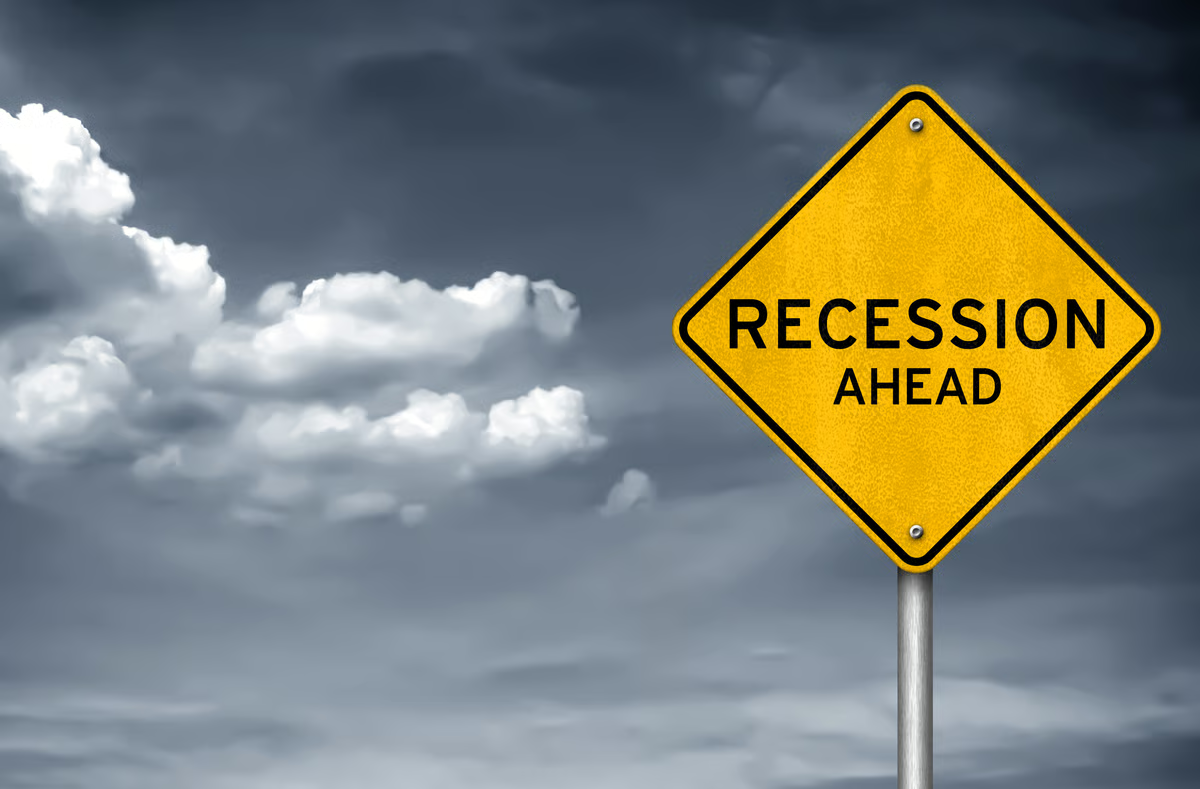
Investors are navigating a complex landscape as forecasts regarding the U.S. economy remain uncertain. While most economists predict that a recession is unlikely in 2026, with J.P. Morgan estimating only a 35% chance of an economic downturn this year, some caution against complacency. The Federal Reserve Bank of New York even suggests an even lower probability based on Treasury spreads. However, it’s essential to consider the historical context when evaluating the potential impacts of a recession on stock investments.
The S&P 500, which began its current form with 500 companies in March 1957, has endured ten recessions since its inception. Notably, the initial recession after the index’s establishment occurred just five months later, in August 1957, following an increase in interest rates aimed at combating inflation. That recession lasted for eight months, and the S&P 500 finished its inaugural year down 11%.
Two additional mild recessions struck within the next 12 years: one in 1960 and another in 1969, with the S&P 500 seeing declines of 2% and nearly 11%, respectively. The severity escalated during the Arab oil embargo in 1973, leading to a notable 19% plunge in the index. The early 1980s witnessed a “double-dip” recession, with the first phase lasting six months and the second beginning in July 1981. While the S&P 500 fell during the first part, it rebounded by nearly 24% by year-end, only to decline almost 8% the following year.
The 1990 and 2001 recessions also saw the S&P 500 decline. However, the recent recessions revealed mixed results for investors. The Great Recession starting in December 2007 saw gains over 4% in that year before a staggering drop of nearly 41% in 2008. In contrast, the COVID-19 recession of 2020 induced a sharp decline, yet the S&P 500 ultimately ended 2020 up approximately 16%.
Historical patterns indicate that the S&P 500 generally struggles during the onset of recessions, with positive returns typically associated with brief recessions or those beginning late in the calendar year. A broader examination reveals that the index tends to recover robustly over the following years post-recession. For instance, five years after the August 1957 recession, the S&P 500 posted a gain of 24%, and ten years later, it experienced a total increase of 103%. Similarly, the recession starting in February 2020 showed a remarkable gain of 309% over a longer term.
Overall, the average returns for the S&P 500 five years after the beginning of a recession approach 54%, while ten-year returns average nearly 113%, barring the 2001 recession following the dot-com bubble burst.
As investors contemplate potential strategies in light of a possible recession in 2026, historical performance suggests that buying stocks remains a sound approach, particularly for long-term investors. Regardless of immediate economic conditions, investing in an index fund tracking the S&P 500 or constructing a diversified stock portfolio tends to yield positive outcomes over a significant time horizon. Thus, while uncertainty looms, history reveals that resilience and strategic investing are often rewarded in the long run.