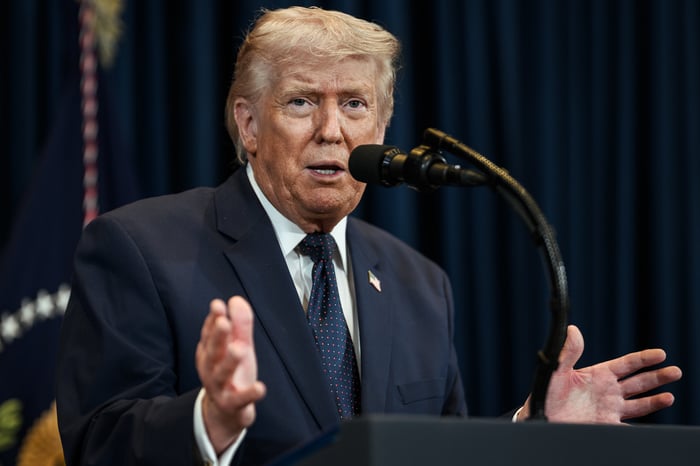
The stock market has shown resilience during Donald Trump’s presidency, with metrics indicating significant gains compared to many of his predecessors. The S&P 500, Dow Jones Industrial Average, and Nasdaq Composite delivered impressive returns during Trump’s first term—57%, 70%, and 142% respectively. This growth pattern has marked Trump’s tenure as one of the most lucrative for investors historically.
However, amidst these successes, widening headwinds pose potential threats to the current bull market. Rising oil prices, driven by geopolitical tensions, especially military actions involving the U.S. and Israel against Iran, have resulted in considerable disruptions to the energy supply chain. The Strait of Hormuz, a critical passageway for about 20% of the world’s daily petroleum consumption, has faced restrictions, contributing to higher consumer fuel costs. Despite this, analysts suggest that the primary concern for Wall Street lies beyond the pump prices.
Investor apprehension intensifies with the current state of the stock market, now classified as historically overpriced. The Shiller Price-to-Earnings (P/E) Ratio, recognized for its inflation-adjusted measure of stock valuation over a decade, suggests the market is at levels seen during past market downturns. Averaging 17.35 since 1871, the ratio recently fluctuated between 39 and 41, marking a significant deviation from historical norms and indicating a potential risk for a considerable market correction.
Historically, high Shiller P/E ratios have coincided with severe equity downturns. Notably, instances where the ratio exceeded 30 during bull markets have resulted in significant losses—previous peaks have led to declines of 20% or more.
Compounding these risks is the unpredictable future of Federal Reserve policy. An unusually high level of dissent within the Federal Open Market Committee (FOMC) has raised concerns about its consistency and credibility. Fed Chair Jerome Powell’s term is set to end soon, with Trump’s nominee, Kevin Warsh, potentially shifting the Fed’s approach toward a focus on higher interest rates. Warsh, characterized as a “hawk,” is likely to prioritize price stability, raising questions about the future trajectory of monetary policy and its impact on borrowing costs and market valuations.
In light of these complexities, investors are advised to reassess their strategies, particularly regarding S&P 500 investments. Current analysis suggests that there may be more promising opportunities in other stocks, as indicated by recent recommendations that have consistently outperformed the index.
In summary, while Trump’s presidency has undeniably played a role in a favorable stock market environment, the intersection of soaring valuations, geopolitical tensions, and evolving Fed policy presents a landscape fraught with uncertainty for investors moving forward.