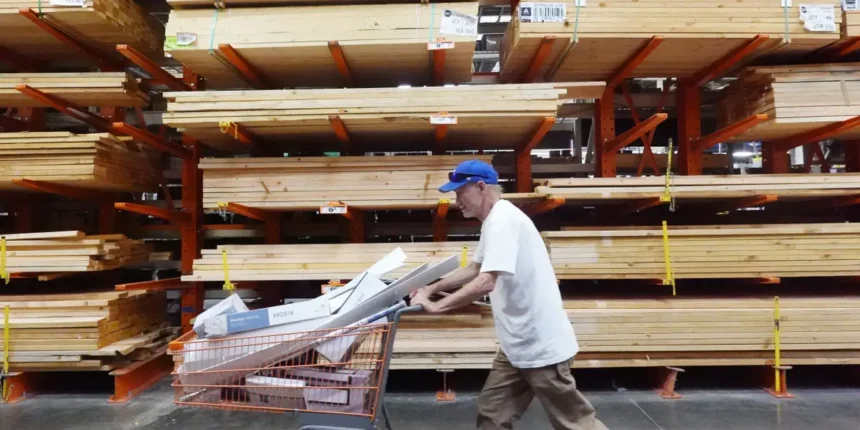
Home Depot has recently joined the ranks of major retailers warning about a noticeable decline in consumer spending, triggering a downward revision of its full-year outlook. The company reported a modest increase in comparable sales of just 0.2% for the third quarter, with U.S. comparable sales up a mere 0.1%. This outcome fell short of Wall Street expectations and highlights a significant shift: even financially stable shoppers are beginning to curtail their spending.
Ted Decker, the chain’s chair, president, and CEO, explained that the anticipated surge in demand during the third quarter failed to materialize. He attributed the current dynamics to “consumer uncertainty” and ongoing pressures in the housing market, which are noticeably reducing the demand for home improvement services. “We believe that consumer uncertainty and continued pressure in housing are disproportionately impacting home improvement demand,” he stated.
Interestingly, trends show that it is not only lower-income consumers who are becoming more cautious; even middle-class shoppers are exhibiting similar behaviors. Home Depot primarily caters to customers with a relatively higher income, and the store usually thrives when home buying and renovation activities increase. However, rising borrowing costs and a stagnant housing market have significantly dampened these activities. The company initially anticipated better performance as interest rates began to ease; however, this shift has not provided the expected boost.
Brian W. Nagel, a senior equity research analyst at Oppenheimer & Co., commented on the situation, stating that Home Depot is grappling with “a convergence of negative factors” that stem from both a decline in housing activity and softer discretionary spending. He noted that the company is not receiving any support from the housing market, which remains stagnant. “The consumer backdrop is going from soft to softer — and that’s happening quickly,” Nagel added.
The company indicated that milder weather patterns and an absence of severe storms have further diminished sales. These conditions typically lead to increased demand for seasonal products such as roofing materials and generators, which generally bolster late-summer revenues. Retail analyst Neil Saunders from GlobalData Retail remarked that the lack of adverse weather conditions affected not only Home Depot but the entire sector, as cautious consumers opted to allocate their budgets towards travel and leisure rather than home enhancements. He estimated that home improvement projects fell by 0.8% compared to the previous year, particularly impacting large remodels requiring financing.
This trend is part of a broader pattern observed in the retail landscape. Earlier this month, McDonald’s CEO Chris Kempczinski noted that higher-income diners are opting for cheaper meal options, emphasizing that “value matters to everybody.” Restaurants such as Cava, Chipotle, and Sweetgreen have also reported a reduction in sales among younger diners, who are increasingly choosing to eat at home to save money. According to Chad Lusk, managing director at consultancy Alvarez & Marsal, some affluent shoppers are shifting towards lower-priced retailers and opting for budget-friendly food options, reallocating their spending towards apparel and electronics. He labeled these changes as signs of significant distress among consumers.
The economic environment is further amplifying this unease. The University of Michigan’s consumer sentiment index fell by 6% in November to a low of 50.3, reflecting diminished confidence across all income brackets, worsened by the ongoing government shutdown. Concurrently, year-ahead inflation expectations have risen to 4.7%, according to preliminary data.
Moreover, the landscape of job security has shifted dramatically, with U.S. employers reporting 153,074 layoffs in October, marking the highest number for that month in over two decades. Overall layoffs for the year have surpassed one million, representing a 65% increase compared to 2024. The outplacement firm Challenger, Gray & Christmas cites cutbacks, AI integration, and dwindling consumer demand as primary influences on this trajectory. The implications of these layoffs are particularly significant for white-collar workers, impacting the retailers that rely on them for sales.
Klarna CEO Sebastian Siemiatkowski articulated the potential long-term effects of AI-related job losses, suggesting that this might transform the typical dynamics experienced during recessions. He indicated that in the medium term, the high-income households could be disproportionately affected due to the job disruptions among white-collar professionals.
For a company that has long served as an indicator of the American homeowner’s financial health, Home Depot’s disappointing performance is a concerning signal. If even its more affluent, middle-class customers are beginning to restrain their spending, the consumer economy as a whole could face a drastically colder winter than anticipated.