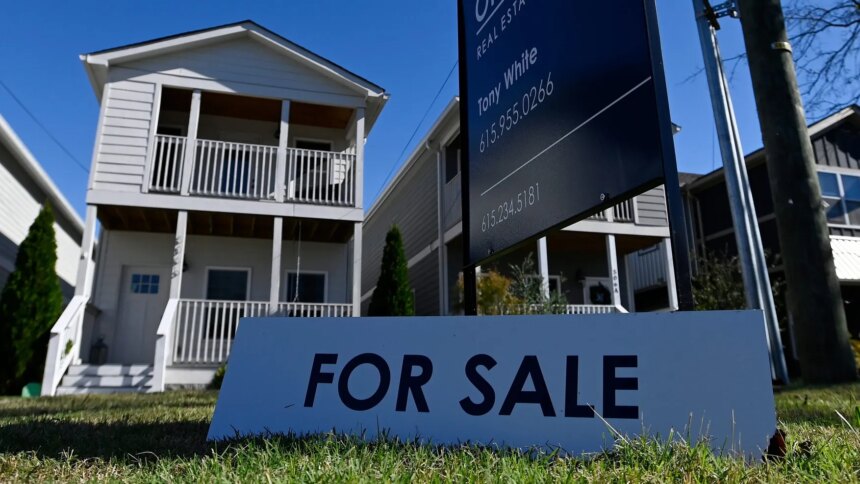
In a recent analysis conducted by The Motley Fool, a startling disparity between the growth rates of home prices and stock prices over the past three decades has been unveiled. Contrary to the common belief that real estate appreciates at a pace similar to that of equities, findings reveal that stock prices have appreciated at four times the rate of home values.
Since 1995, home prices have seen an approximate increase of 310%, while the S&P 500 index skyrocketed by a staggering 1,200%. When factoring in dividends, total returns from the S&P exceeded an impressive 2,200%. Matthew Argersinger, a senior investment analyst at The Motley Fool, emphasized that stocks have consistently proven to be the best-performing asset class, stating, “Nothing really comes close.”
A further breakdown shows that between 1992 and 2024, the S&P yielded an average annual return of 10.4%, while home prices grew at approximately 5.5% annually. Given these figures, Caleb Silver, editor in chief of Investopedia, stated, “If your objective is to invest either in a home or the stock market to generate long-term wealth that will help you retire, the stock market is unquestionably the better performer.” However, he added the caveat that owning a home provides a fundamental need for shelter.
Brian Kearns, a CPA and certified financial planner based in Chicago, shared insights on the multifaceted nature of homeownership. He suggested that a home should be viewed not only as an investment but also as a place where individuals live and create memories. He emphasized that it is crucial to understand that a home serves both as shelter and a significant financial investment, albeit one that should not be compared directly to stock investments due to their inherent differences.
As many individuals face the dilemma of how best to allocate their limited funds, two prominent options emerge: purchasing a home or opting to rent. Buying a home often involves entering a cycle of significant mortgage payments and ongoing maintenance costs, while renting may allow for increased liquidity and the potential to invest in securities. Given the historical performance of stocks, Silver noted that renting could be a more efficient method for wealth building.
Despite the rising home prices of the past several years, which have increased by nearly 40% in the first half of the decade alone, the assumption that home prices continually skyrocket is challenged by the statistics. The average home sale price reached approximately $512,800 in mid-2025, up from $371,100 five years earlier. When examined in percentage terms, this rise pales in comparison to the 86% increase seen in the S&P 500 over the same timeframe.
Amy Arnott, a portfolio strategist at Morningstar, pointed out that while a home should maintain its value over time, it typically does not provide the exceptional growth potential found in stock investments. She articulated that owning a home may serve as a financial stepping-stone for individuals seeking to lift themselves out of poverty through equity buildup.
A comparison of homeownership and stock investments highlights several factors of consideration. For example, while home prices may be more stable, they do not experience the same level of volatility as stocks. Over the past decade, home prices have demonstrated a consistent upward trend, while the S&P has experienced more drastic fluctuations, losing as much as 18% in a single year.
Additionally, homes offer tangible benefits beyond purely financial returns. They provide living spaces and can generate rental income, representing a unique intrinsic value that stocks do not. However, the liquidity of investments may shift in favor of stocks, which are easier to buy and sell compared to real estate.
Investing in a home often requires paying a significant amount upfront in the form of a down payment, but it allows homeowners to build equity over time. Conversely, the maintenance costs of homeownership can accumulate quickly, averaging nearly $16,000 annually, according to a study by Zillow and Thumbtack. In stark contrast, the management costs of stock investments remain relatively low.
Tax benefits add another layer to the homeownership debate, as homeowners can deduct mortgage interest and property taxes, while stock investors face capital gains taxes upon selling profitable stocks. Ultimately, the decision to invest in real estate or equities hinges on individual financial goals, lifestyle needs, and risk tolerance.