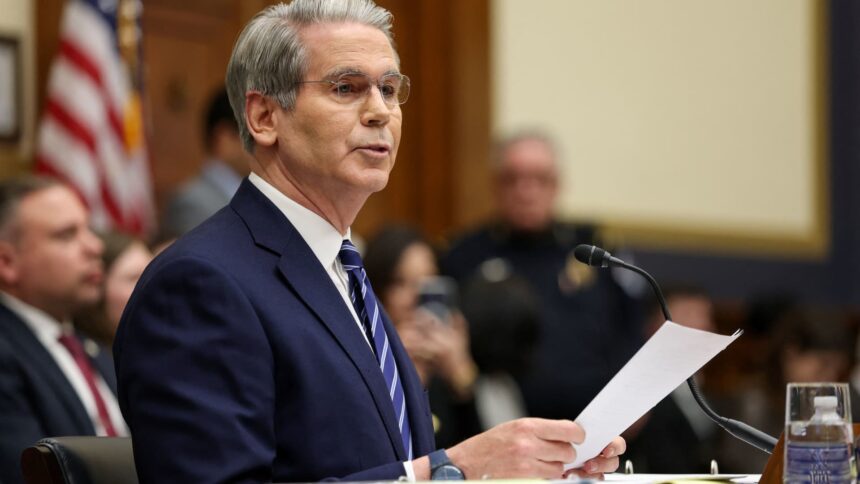
Dozens of House Democrats have formally called upon U.S. Treasury Secretary Scott Bessent to investigate potential conflicts of interest and national security issues surrounding World Liberty Financial, a cryptocurrency venture tied to the Trump family. The letter, spearheaded by Rep. Gregory Meeks of New York and supported by over 40 lawmakers, follows Bessent’s recent testimony at a House Financial Services Committee hearing, where tensions ran high.
During the hearing, Meeks criticized Bessent, branding him a “flunky” of former President Donald Trump, and flagged concerns over a significant $500 million investment made by Sheikh Tahnoon bin Zayed Al Nahyan of the United Arab Emirates—a figure often referred to as the “spy sheikh.” Meeks stated that the connection between the Trump family’s venture and the Emirati royal family poses threats not only to financial stability but also to national security. He asserted, “Trust that the record will reflect whether Secretary Bessent chooses to answer to the American people, or his mob boss,” highlighting the gravity of the situation.
World Liberty Financial is currently in the process of seeking a national bank charter from the Office of the Comptroller of the Currency (OCC), which operates independently within the Treasury Department to regulate banking institutions. Recently, the company held a promotional forum at Mar-a-Lago, featuring presidential sons Don Jr. and Eric Trump, who criticized traditional banking systems as “Ponzi schemes” while promoting their own stablecoin initiative.
Meeks urged Bessent during the hearing to pause any pending applications from World Liberty Financial pending a thorough investigation into potential conflicts of interest and foreign influence. In response, Bessent maintained that the OCC is an independent entity and did not elaborate further amidst Meeks’ inquiries.
As the scrutiny intensifies, lawmakers have emphasized that the issue extends beyond cryptocurrency discussions; it is fundamentally about foreign ownership, national security, and the integrity of regulatory processes. They seek clarity on the protective measures in place to prevent foreign entities or politically connected investors from leveraging the bank-chartering process to gain undue influence over the U.S. financial system.
Additionally, the letter seeks information regarding the roles played by the White House, the Office of Management and Budget, and the Treasury in the review and approval processes related to national bank or trust charters. The Democratic members requested a formal response from the Treasury by February 26.
Highlighting the importance of the matter, lawmakers underscored that the credibility of America’s banking regulatory framework hinges on transparency and the ability to resist any external pressures. “Our constituents need confidence that our banking system is governed by law, not proximity to power; by prudential judgment, not political convenience,” they concluded, underscoring the critical nature of maintaining public trust in financial institutions.