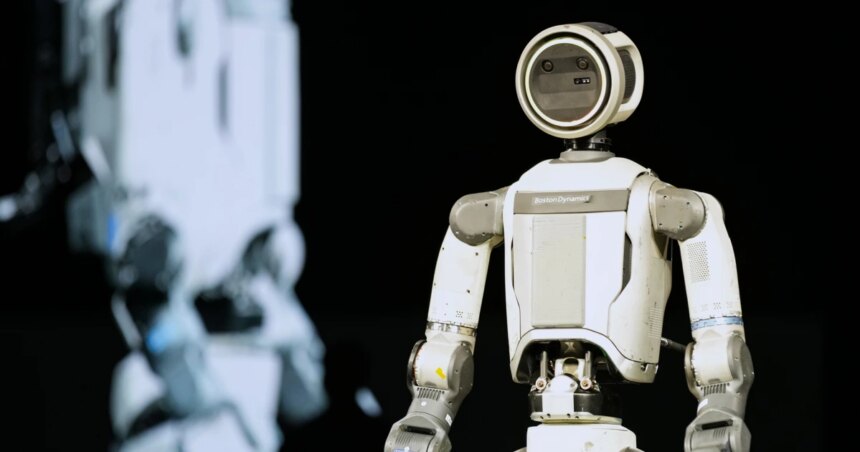
Hyundai-owned Boston Dynamics captivated attendees at the CES technology showcase on Monday with the public debut of its humanoid robot, Atlas. The unveiling marked a significant milestone in the competition among technology giants, including Tesla, to develop robots that closely mimic human behavior.
Zachary Jackowski, general manager for humanoid robots at Boston Dynamics, introduced Atlas as it emerged from the floor of a Las Vegas hotel ballroom. The life-sized robot, equipped with two arms and legs, showcased its abilities by walking fluidly around the stage, engaging the audience by waving and turning its head. Despite the impressive display, an engineer controlled Atlas remotely, although it will be capable of independent movement in real-world applications.
Boston Dynamics revealed that a version of Atlas, designed to assist in car assembly, is already in production and is slated for deployment by 2028 at Hyundai’s electric vehicle manufacturing facility near Savannah, Georgia. This announcement underscores the South Korean carmaker’s commitment to integrating advanced robotics into its operations, especially given its controlling stake in Boston Dynamics, a company recognized for decades of innovation in robotics, notably its dog-like robot, Spot.
As part of the event’s opening, a group of Spot robots entertained the audience with a choreographed dance routine set to a K-pop song, adding vibrancy to the showcase.
In a strategic announcement, Hyundai also confirmed a new partnership with Google’s DeepMind. Through this collaboration, DeepMind will provide artificial intelligence technology to enhance Boston Dynamics’ robots. This partnership marks a return play for Google, which once owned Boston Dynamics before selling it to SoftBank, which in turn sold it to Hyundai in 2021.
Public demonstrations of humanoid robots are infrequent, largely due to the potential for missteps that can attract negative attention—evident in past demonstrations when similar robots encountered mishaps. Many robotics startups often showcase their prototypes through carefully edited videos on social media to present their best showcases.
Concluding the Atlas demonstration, which appeared seamless, the humanoid robot dramatically introduced a static model of its commercial version, notable for its blue color and slight design differences.
The growing excitement surrounding artificial intelligence and recent technological advancements has led to substantial investments in robotics. However, experts caution that fully human-like robots capable of completing a wide array of tasks in homes or workplaces are still years away. Alex Panas, a partner at consulting firm McKinsey, emphasized the importance of understanding the practical applications of such technology, noting, “the software, the chipsets, the communication, all the other pieces of the technology are coming together, and they will create new applications.”
While the current capabilities of humanoid robots do not pose a significant threat to human jobs, as their dexterity remains limited, the discourse surrounding their potential impact on employment is expected to intensify as their skills evolve. Notably, the Georgia facility set to test Atlas was previously the site of a federal immigration raid, which resulted in the arrest of hundreds of workers, including over 300 South Korean nationals.