IBM has made significant strides in quantum computing with the introduction of two new processors, Nighthawk and Loon, outlined in a recent announcement. Nighthawk incorporates 120 qubits and 218 couplers, enabling it to support circuits with up to 5,000 two-qubit gates. This is a pivotal achievement for IBM’s plan to reach a community-validated quantum advantage by 2026, and to meet fault tolerance milestones by 2029.
The concept of “quantum advantage” refers to the point at which a quantum computer can outperform any traditional computer in specific tasks. On the other hand, fault tolerance signifies a quantum computer’s ability to maintain reliable performance despite errors during computation. If IBM’s ambitious roadmap is successful, the Nighthawk processor could play a crucial role in paving the way for commercially viable quantum computers by the conclusion of the decade.
While IBM’s latest advancements put the industry a step closer to what is often referred to as “Q-Day,” the new processors are not yet a concern for Bitcoin’s security systems. Current projections suggest that breaking Bitcoin’s elliptic curve cryptography would necessitate a fault-tolerant quantum system with approximately 2,000 logical qubits, which translates to tens of millions of physical qubits when factoring in error correction. Nighthawk is specifically designed to execute more complex computations while keeping error rates low.
The initial systems powered by Nighthawk are anticipated to be available to users by late 2025. Future iterations could surpass 1,000 connected qubits by 2028. The architecture of the Nighthawk chip enhances connectivity between qubits via 218 tunable couplers, representing a 20% increase compared to IBM’s Heron design from 2023. This upgraded configuration enables a roughly 30% increase in circuit complexity, thereby supporting significantly larger computations.
Nighthawk is part of IBM’s Starling roadmap, which includes a series of objectives aimed at creating a large-scale, fault-tolerant quantum computer—dubbed IBM Quantum Starling—by 2029. Achieving the goal of a scalable quantum computer for real-world applications will require breakthroughs in modular architecture and error correction, among other innovations outlined in the Starling initiative.
IBM’s announcement comes amid a resurgence of investment in quantum computing. Recently, Google revealed that its Willow processor achieved a verified quantum speed-up, performing a physics simulation more efficiently than any classical supercomputer. This development raised fresh concerns regarding the security of Bitcoin’s encryption.
To further its quantum goals, IBM has teamed up with Algorithmiq, the Flatiron Institute, and BlueQubit to launch a quantum-advantage tracker, an open-source platform designed for comparing outcomes from quantum and classical approaches in benchmark experiments. In tandem with these advancements, IBM revealed plans to expand its Qiskit software to align with its new hardware capabilities. Notably, dynamic circuits in Qiskit have reportedly improved accuracy by 24% at the 100-qubit scale, and a new C-API interface will connect Qiskit with high-performance classical systems, enhancing error mitigation and significantly reducing the costs associated with obtaining precise results.
Additionally, IBM made strides with its experimental Quantum Loon processor, which is said to demonstrate all critical hardware features required for fault-tolerant quantum computing. This chip architecture leverages established technologies, such as long-range “c-couplers” to connect distant qubits and mechanisms for qubit reset between operations. IBM has reported a tenfold improvement in error-decoding performance, achieving real-time corrections in under 480 nanoseconds using qLDPC codes—this milestone was reportedly realized a year ahead of schedule.
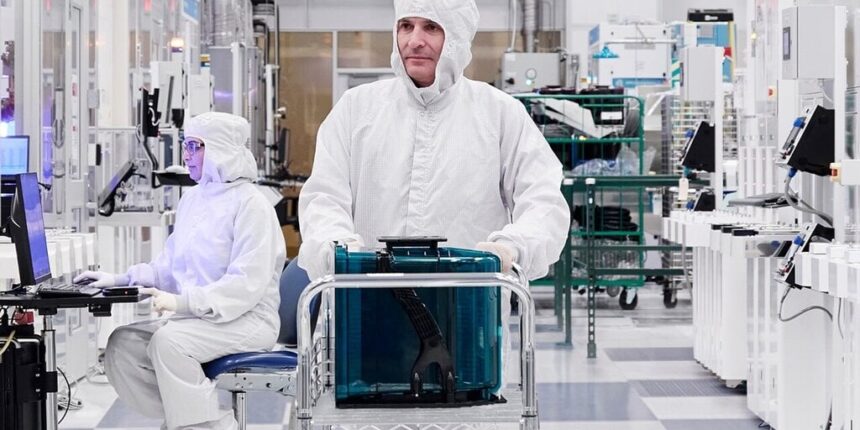
In an effort to hasten development, IBM has shifted its quantum chip production to a 300-millimeter wafer line at the Albany NanoTech Complex in New York. This strategic move is said to have doubled research speed, increased chip complexity tenfold, and facilitated the parallel development of multiple processor designs.
These updates signify ongoing progress toward scalable, fault-tolerant quantum systems and lay the foundation for community-verified demonstrations of quantum advantage in the near future. IBM Research Director Jay Gambetta expressed confidence, stating that the company is uniquely positioned to rapidly innovate and scale various aspects of quantum software, hardware, fabrication, and error correction to unlock transformative applications.