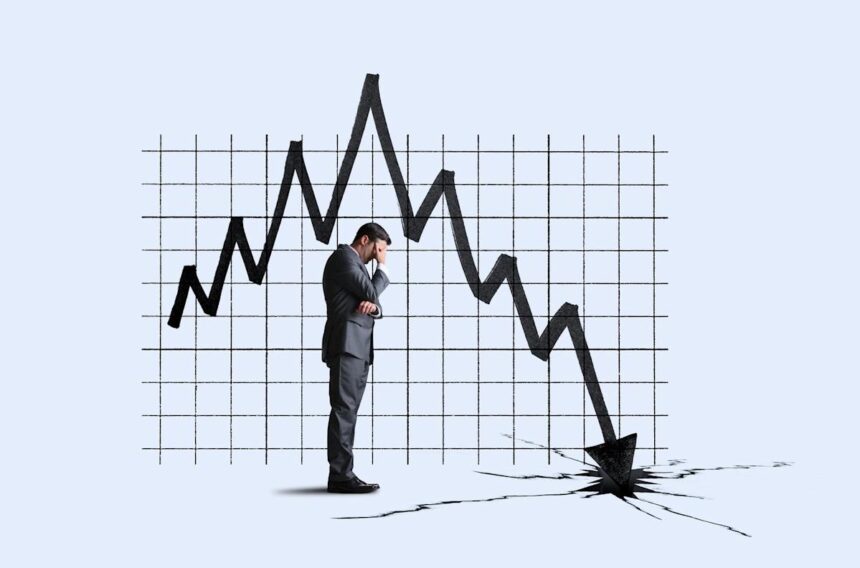
Stock prices are currently experiencing a downturn, with major indexes recently marking new low points for the year. The S&P 500 has slipped nearly 6% from its peak, while the Nasdaq Composite has fallen by about 9%, recently entering correction territory. Despite these declines, this situation does not amount to a market crash, and the U.S. economy is not officially in a recession. However, should the economic landscape deteriorate further, investors may want to consider three strategic moves to protect their portfolios.
With stock prices in a downward spiral, investors may feel the urge to liquidate their holdings to prevent further losses. The challenge lies in the unpredictability of market trends; selling now could mean locking in losses if the market experiences a quick rebound. Historical patterns indicate that major indices can recover swiftly from steep declines. For instance, during the early days of the COVID-19 pandemic, the S&P 500 lost approximately one-third of its value in less than a month, only to rebound sharply and reach new highs shortly after.
The current market’s trajectory remains uncertain. While it could continue to decline, it is also plausible that we could see a rebound similar to previous recoveries. Investors looking at a long-term horizon may find that short-term fluctuations matter less. Historically, major indexes have often set new records over decades, with the average bear market since 1929 lasting around nine months, compared to an average bull market lasting nearly three years. Despite volatility and recessions, positive market trends have historically outweighed negative ones.
Investors who held onto an S&P 500 index fund since January 2000 have seen remarkable returns of approximately 625% despite numerous market ups and downs over the last two decades. Selecting high-quality stocks from financially robust companies can further hedge against volatility and enhance the likelihood of achieving positive long-term returns. Companies with strong fundamentals—including financial health, competitive advantages, competent management, and growth potential—are more likely to endure turbulent economic times, while weaker companies may falter during downturns.
For those who worry about missing opportunities in successful stocks, there are occasions when expert analysts recommend certain “Double Down” stocks—companies anticipated to perform well soon. Historical data shows substantial returns from prior recommendations: a $1,000 investment in Nvidia in 2009 would have grown to roughly $460,126, while a similar investment in Apple in 2008 would have yielded about $48,732. Netflix has shown even more remarkable growth, with a $1,000 investment from 2004 turning into approximately $532,066.
At this juncture, investment recommendations for three promising companies are available to those joining specific advisory services, underscoring the potential for gains in the current market landscape. As always, understanding one’s individual financial situation and aligning investment strategies with long-term goals remains crucial for navigating the complexities of the stock market.